China’s top factories still power global trade, but the real advantage today is how B2B sellers connect to them. This expert guide explains China’s manufacturing giants and how platforms like Looperbuy enable factory‑price sourcing, integrated logistics and low‑risk dropshipping worldwide.
As a B2B sourcing strategist working with cross‑border sellers since 2014, I’ve watched China’s top factories evolve from pure “world’s factory” workhorses into high‑tech ecosystems that quietly power Amazon, Walmart, and countless B2B brands worldwide. For global sellers, the real advantage is no longer just low unit cost—it’s how you plug into these giants efficiently through modern one‑stop platforms like Looperbuy.
Table of Contents
Understanding China’s Manufacturing Powerhouse
China still earns the nickname “world’s factory” for a reason: its manufacturing ecosystem covers everything from high‑end electronics and vehicles to home appliances and industrial equipment. Decades of investment in infrastructure, skilled labor, and export‑oriented policy created a dense network of factories that now support most major B2C platforms you know today. [globalsources]
From my own work with international brands, I see three practical strengths every week:
– Scale at speed – factories regularly ramp production from pilot runs to hundreds of thousands of units with predictable lead times.
– Category depth – from entry‑level consumer goods to complex OEM parts, you can usually find multiple qualified factories in China for the same product.
– Tech‑driven operations – leading plants are quietly adopting robotics, IoT, and AI to stabilize quality and reduce defects.
This “industrial backbone” matters for B2B sellers and wholesalers, because it determines whether your cross‑border business scales or stalls when orders spike.
Inside China’s Most Influential Factories
When buyers ask me which Chinese manufacturers matter most to global B2B commerce, I start with the handful of giants that shape entire product categories. These are not just big brands—they are hidden infrastructure behind the goods your customers use every day. [globalsources]
Foxconn Technology Group: Contract Electronics At Unmatched Scale
Foxconn, officially Hon Hai Precision Industry, remains the world’s largest contract electronics manufacturer, and its massive Longhua campus in Shenzhen can reportedly produce up to 500,000 smartphones per day. [globalsources]
What this means for global sellers:
– High‑volume electronics – smartphones, tablets, computers, consoles and accessories that flow into marketplaces worldwide.
– Rapid scaling capability – if a device category suddenly surges, Foxconn‑related supply chains often absorb the shock first. [globalsources]
– Automation and cost control – heavy investment in robotics and AI keeps production efficient, which indirectly stabilizes global pricing.
Foxconn’s history of labor‑practice criticism has also forced stricter oversight and transparency, which is part of why serious brands still entrust complex projects to this ecosystem.
BYD Company Limited: Electric Vehicles And Battery Innovation
BYD started as a battery maker and turned itself into one of the world’s largest electric vehicle manufacturers, with major bases in Shenzhen, Xi’an and Changsha.
For B2B buyers in automotive and energy:
– Vertically integrated EV supply – batteries, vehicles, and key electronics under one roof reduce multi‑supplier risk. [globalsources]
– Global footprint – factories and partnerships in the US, Brazil, Hungary and beyond make BYD relevant far outside China.
– Sustainability positioning – BYD’s clean‑energy focus helps downstream brands align with low‑carbon procurement strategies.
Haier Group: Smart Home Appliances For Global Distribution
Haier grew from a small refrigerator plant into the world’s largest home appliance manufacturer, anchored by its enormous industrial park in Qingdao. [globalsources]
Why this matters for global wholesalers and retailers:
– Full home appliance lines – refrigerators, washing machines, AC units, TVs and more from one ecosystem.
– Smart factory practices – extensive use of IoT and data analytics to improve efficiency and reduce defects.
– Multi‑regional manufacturing – industrial parks across China support regional specialization and shorten certain lead times.
Huawei, Lenovo, SAIC Motor, Midea, Gree, TCL, Xiaomi
These names often show up in consumer headlines, but for B2B sourcing they function as anchor manufacturers in their respective categories: [globalsources]
– Huawei – telecommunications infrastructure and smart devices, backed by heavily automated manufacturing centers and large R&D spend.
– Lenovo – global PC leader with high‑automation in Hefei and strong experience in Industry 4.0 practices. [globalsources]
– SAIC Motor – China’s largest automotive manufacturer with major joint ventures with Volkswagen and GM, plus dedicated NEV lines.
– Midea & Gree – dominant in HVAC and appliances, pairing mass‑scale plants with in‑house industrial automation and robotics capabilities. [linkedin]
– TCL & Xiaomi – electronics brands that marry panel manufacturing (TCL) and smart‑factory smartphone lines (Xiaomi) with fast‑moving consumer ecosystems.
Collectively, these companies anchor supply in electronics, home appliances, HVAC, automotive and smart devices—the same categories global B2B sellers rely on to build private‑label and wholesale portfolios. [linkedin]
How Global Sellers Actually Find And Work With Chinese Suppliers
Most of the Amazon, Temu, Wish, eBay, Shein and Walmart sellers I advise do not call Foxconn or BYD directly. Instead, they build supply chains through a mix of strategic factory partnerships and trusted B2B channels. [globalsources]
Typical procurement behavior looks like this:
– Long‑term relationships with 1–3 core factories for major SKUs.
– Face‑to‑face scouting at trade shows to discover new lines and check samples.
– Heavy use of third‑party B2B platforms to identify verified suppliers at scale.
Global Sources, for example, has spent more than 50 years developing a curated B2B marketplace serving over 10 million registered buyers and users, including 97 of the world’s top 100 retailers. It connects sellers on platforms like Amazon, Temu, Wish, eBay, Shein, Walmart and Etsy with vetted suppliers in China, Vietnam, South Korea and India. [globalsources]
However, many mid‑size B2B sellers now want to go one step further: factory pricing, minimal intermediaries, and integrated logistics rather than just a product directory.
Why One‑Stop B2B Platforms Are Now Essential
Over the past decade, I’ve watched traditional sourcing channels become increasingly painful for small and mid‑size B2B businesses:
– Unvetted suppliers create inconsistent quality and compliance risk.
– Multiple middlemen make “cheap” unit prices far less competitive once total landed cost is calculated. [jtlgo]
– Fragmented supplier bases force buyers to juggle multiple vendors and freight providers. [jtlgo]
– Shipping delays and poor tracking erode end‑customer trust.
Modern product sourcing companies emerged to fix this by combining supplier vetting, cost visibility and logistics integration into a single platform. The global sourcing and procurement services market itself reached about USD 3.357 billion in 2025 and is projected to grow to USD 5.152 billion by 2032, at around 6.4% CAGR, underlining how quickly professionalized sourcing is becoming standard. [jtlgo]
For a cross‑border B2B seller, the result is simple: you spend less time firefighting supply chain issues and more time growing your catalog and markets.
Looperbuy: Direct China Sourcing For Global B2B Sellers
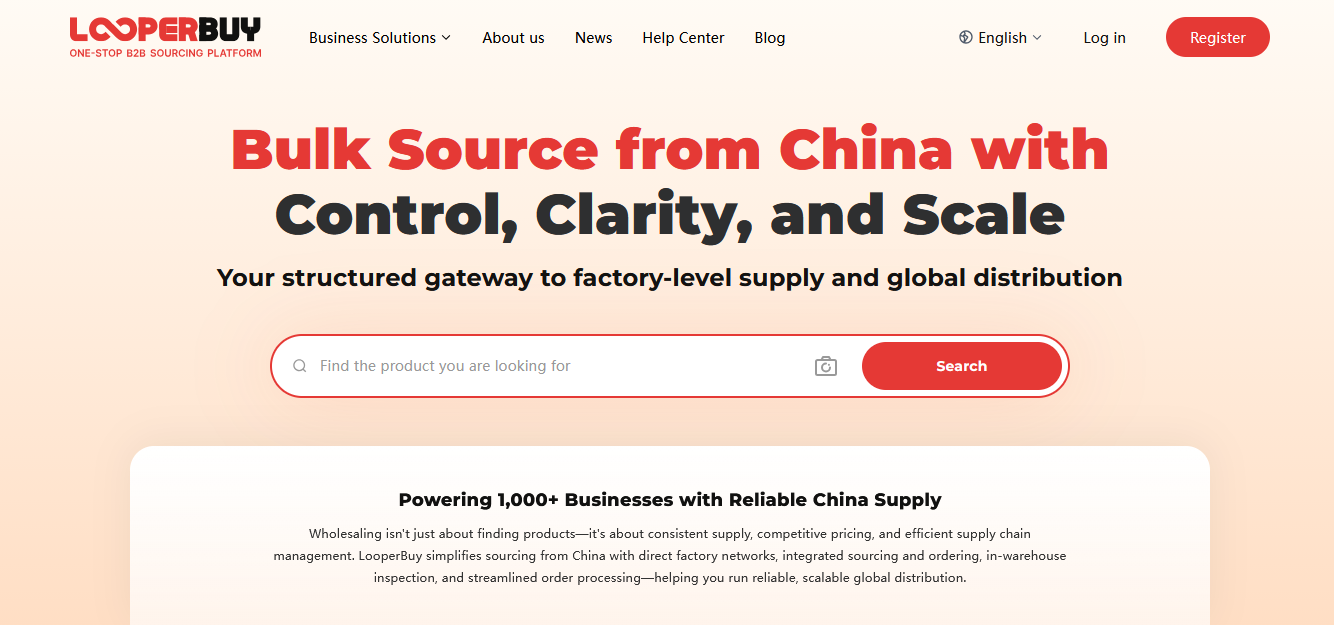
Looperbuy is one of the platforms designed specifically for overseas merchants who want reliable access to China’s domestic manufacturing ecosystem without building an on‑the‑ground team. [looperbuy]
Founded in 2024, the platform connects directly to 1688.com, China’s largest domestic B2B wholesale marketplace. This matters because many factories price more aggressively on 1688 than on international marketplaces; Looperbuy helps overseas users reach those factory‑direct offers with typical pricing that can be 12–28% lower than many global platforms. [looperbuy]
Key capabilities you can leverage as a global seller: [looperbuy]
– Direct factory access – integration with 1688 and 10,000+ certified Chinese factories across 50+ categories.
– Cost competitiveness – removal of traditional middlemen and transparent calculators showing product, transport, duties and delivery in one view. [jtlgo]
– Integrated logistics – cooperation with high‑quality logistics providers, consolidated shipping, and “traceless dropshipping” that hides supplier information in end‑customer parcels. [looperbuy]
– Payment reliability – partnership with LianLian Global to support multi‑currency cross‑border payments and reduce friction in settlement.
Looperbuy’s internal data and industry sources highlight that 1688’s GMV approaches RMB 1 trillion, with over RMB 200 billion tied to overseas small‑business procurement. That volume suggests a structural shift: global buyers are no longer limited to export‑oriented suppliers—they can increasingly tap into domestic Chinese pricing through platforms tuned for cross‑border use.
Comparing Manufacturing Giants And Modern Sourcing Platforms
Below is a concise view of how the major factories and a one‑stop platform like Looperbuy play different roles in your B2B supply chain: [looperbuy]
| Entity | Primary Role | Typical Buyer Use Case | Strength For B2B Sellers |
| Foxconn | Contract electronics manufacturing | High‑volume devices, OEM projects | Massive scale, advanced automation |
| BYD | EVs and batteries | Automotive, energy and mobility | Vertical integration, clean‑energy positioning |
| Haier | Home appliances | White‑label appliances, retail lines | Smart factories, wide category coverage |
| SAIC Motor | Automotive manufacturing | Vehicle OEM and components | Joint ventures, NEV development |
| Midea & Gree | HVAC and appliances | Climate control, home appliances | Industrial automation, global footprint |
| TCL & Xiaomi | Consumer electronics | TVs, smartphones, smart devices | Display tech (TCL), smart factories (Xiaomi) |
| Global Sources | Curated B2B marketplace | Multi‑country supplier discovery | Vetted suppliers, trade show integration |
| Looperbuy | Direct B2B sourcing platform | Factory‑price sourcing + logistics from China | 1688 integration, cost transparency, end‑to‑end visibility |
A Practical Framework To Source From China Without Chaos
From an operational perspective, most successful B2B buyers follow a consistent, step‑by‑step approach when they start or upgrade their China sourcing:
1. Clarify requirements – product specs, volumes, compliance needs, target margins and delivery deadlines.
2. Identify sourcing channels – mix of curated marketplaces (Global Sources), one‑stop platforms (Looperbuy), and direct factory outreach in strategic categories. [jtlgo]
3. Verify suppliers rigorously – capacity checks, ISO/CE documentation, production history, and sample testing before committing to large orders.
4. Model total landed cost – include product price, inland transport, export procedures, international freight, customs duties and final‑mile delivery in a single calculation.
5. Build real‑time visibility – insist on production updates, pre‑shipment inspections and shipment tracking from factory to warehouse.
Platforms like Looperbuy bundle much of this into a single workflow, especially for overseas buyers without local staff. You still need professional judgment, but you start with a far stronger baseline. [looperbuy]
Choose the Right Platform to Build Your Store
For wholesalers, brand owners and B2B marketplace sellers, China’s manufacturing giants will likely remain the backbone of your supply chain for years to come. The real strategic question is how you connect to them: through fragmented channels and one‑off agents, or through integrated platforms that combine vetted factories, transparent costing and reliable logistics.
If you’re ready to reduce inventory risk, cut hidden fees and streamline cross‑border operations, it’s a natural next step to explore platforms built for global B2B sourcing. Visit Looperbuy to register, compare factory‑direct offers from thousands of certified Chinese suppliers, and start testing one‑piece dropshipping or bulk procurement with full cost visibility and end‑to‑end tracking.
Frequently Asked Questions (FAQ)
1. Why do so many global sellers still rely on Chinese factories?
China offers unmatched depth across electronics, textiles, machinery, automotive and consumer goods, supported by advanced infrastructure and competitive labor costs. This combination allows B2B buyers to balance price, quality and volume scalability in a single manufacturing hub. [sohoinchina]
2. Is it better to work directly with big factories or through sourcing platforms?
Large manufacturers like Foxconn or BYD usually focus on high‑volume or strategic accounts, which can be difficult for smaller buyers to access. Sourcing platforms provide broader reach, pre‑vet factories, and consolidate logistics, making them more practical for most small and mid‑size B2B businesses. [jtlgo]
3. How does Looperbuy differ from traditional B2B marketplaces?
Looperbuy integrates directly with 1688.com and connects overseas buyers to 10,000+ certified factories with transparent calculators covering product cost, freight, duties and delivery. It also partners with logistics providers and payment platforms to offer one‑stop dropshipping and bulk procurement services. [looperbuy]
4. Can I avoid holding inventory when sourcing from China?
Yes. By using services such as one‑piece dropshipping and consolidated fulfillment, you can ship directly from Chinese warehouses to end customers, reducing warehousing and inventory risks. Many platforms now support “traceless” shipping that hides factory details while protecting your brand. [looperbuy]
5. What’s the first step if my company has never sourced from China?
Start by defining product requirements, compliance needs and target margins, then trial a small order through a vetted platform like Looperbuy to validate quality, lead times and logistics. Use that pilot to refine specifications and build a scalable sourcing plan for future orders. [looperbuy]
References
1. Global Sources. “Top 10 Manufacturing Companies in China.” Global Sources Knowledge Center, 2024. [globalsources]
2. Looperbuy. “Product Sourcing Companies: A B2B Expert’s Guide to Sourcing Chinese Goods Globally with LooperBuy.” Looperbuy Blog, 2026. [jtlgo]
3. Looperbuy. “Online B2B sourcing platform, China purchase, Chinese suppliers.” Looperbuy Resources, 2025. [looperbuy]
4. QYResearch via Gelonghui. “Global Sourcing and Procurement Services Market Analysis 2025–2032.” 2026. [jtlgo]
5. LinkedIn. “Chinese factories: Top 5 largest factories in China.” 2022. [linkedin]