Discover how to choose the best dropshipping manufacturers for custom packaging, private label fulfillment, and global shipping. This guide explains packaging options, supplier evaluation, quality control, cost planning, compliance considerations, and a step-by-step rollout strategy for brands sourcing from China through Looperbuy.
The best dropshipping manufacturers for custom packaging do more than print a logo on a box. They help sellers create a consistent unboxing experience, protect products during international delivery, manage low-volume production, and ship orders directly to customers without forcing the seller to hold inventory.
For modern B2B sellers, branded packaging is no longer reserved for large retail chains. With the right China sourcing and fulfillment partner, smaller ecommerce brands, wholesalers, subscription businesses, and marketplace sellers can introduce custom packaging in stages—starting with inserts, stickers, and mailers, then moving toward fully customized boxes as order volume becomes predictable.
Table of Contents
What Makes a Dropshipping Manufacturer Suitable for Custom Packaging?
A dropshipping manufacturer is a supplier that can produce or source goods and send individual orders directly to your end customers. A custom packaging manufacturer adds branding, protective materials, labeling, inserts, and presentation elements to that fulfillment process.
The best partner combines product sourcing, packaging customization, quality control, warehousing, and direct shipping in one coordinated workflow.
For a seller, this matters because packaging is not a separate design project. It is part of the full customer experience.
A strong custom packaging dropshipping workflow should look like this:
1. You select or develop a product.
2. The supplier confirms materials, product specifications, and packaging needs.
3. Your packaging artwork is reviewed before production.
4. Products and packaging materials are checked before dispatch.
5. The order is packed according to your instructions.
6. The fulfillment partner ships directly to the customer.
7. Tracking information is passed back to your store or sales team.
This model can reduce the need to purchase large quantities of finished goods in advance. It can also help global sellers avoid handling every small parcel themselves.
The Difference Between a Supplier and a Fulfillment Partner
Many businesses begin by searching for “custom packaging suppliers” or “private label manufacturers.” That is a useful starting point, but it can create operational gaps.
A packaging factory may make boxes very well, but it may not store your goods, combine products into kits, inspect finished orders, or ship worldwide. A product factory may make your item, but have limited ability to work with multiple packaging vendors. A traditional freight forwarder may move cartons internationally, but may not handle individual consumer orders.
A more complete dropshipping partner coordinates those functions.
| Capability | Packaging-Only Factory | Product Manufacturer | Integrated Dropshipping Partner |
| Custom boxes and inserts | Usually strong | Varies | Can coordinate or source |
| Product sourcing | No | Yes, limited to its category | Yes, across multiple categories |
| Low-volume branding | Sometimes limited | Often limited | Usually more flexible |
| Product inspection | No | Internal only | Can perform order-level checks |
| Warehousing | Rarely | Sometimes | Core service |
| Bundle or kitting work | Rarely | Limited | Usually available |
| Direct-to-customer shipping | Rarely | Sometimes | Core service |
| Multi-supplier consolidation | No | No | Usually available |
The key lesson: choose a partner based on the entire path from factory to customer, not only on the price of one printed box.
Types of Custom Packaging for Dropshipping Brands
Not every brand needs a fully printed rigid box on day one. In fact, starting with a simpler packaging layer can protect cash flow while still making orders feel intentional and recognizable.
Shopify’s packaging guidance recommends beginning with stock packaging and adding branded elements such as stickers and labels before committing to fully printed boxes. This staged approach is especially useful for product testing, seasonal collections, and early-stage brands.
1. Branded Shipping Boxes
Custom shipping boxes are suitable for products that need strong outer protection, including:
– Electronics and accessories
– Home goods
– Cosmetics gift sets
– Subscription boxes
– Premium apparel
– Fragile items
– Corporate gifts
Printed corrugated boxes can include your logo, brand colors, website, QR code, handling instructions, or campaign graphics.
However, they normally require more planning. Box dimensions, board strength, print method, minimum order quantity, storage space, and shipping weight all affect cost.
Best for: brands with stable product dimensions and consistent order volume.
2. Custom Mailers and Poly Bags
Mailer bags are lightweight and practical for clothing, accessories, stationery, and soft products. They may be poly mailers, paper mailers, padded mailers, or reusable shipping bags.
They are often easier to store than boxes and can lower dimensional-weight exposure on some shipping routes.
Best for: apparel brands, accessory stores, lightweight consumer goods, and sellers testing new products.
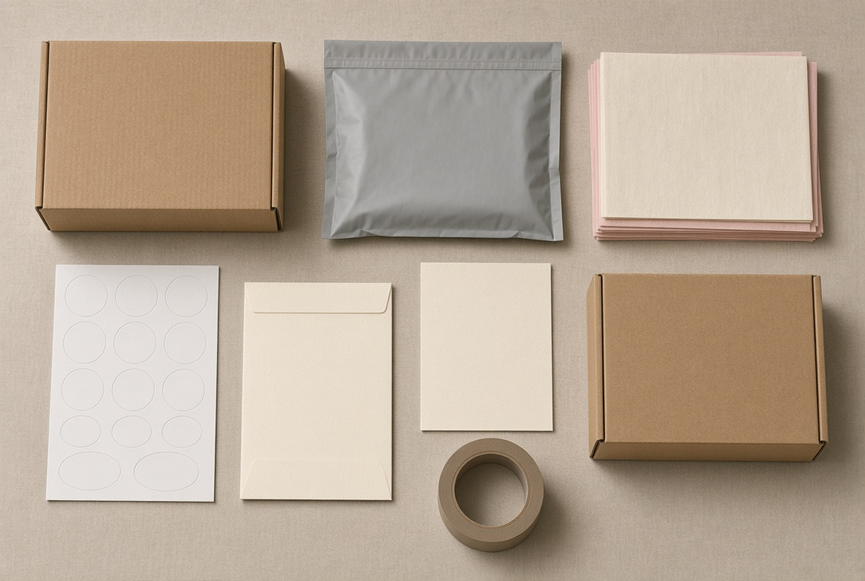
3. Tissue Paper, Stickers, and Thank-You Cards
This is often the smartest starting point for dropshipping sellers.
A standard unbranded carton can become a branded order with:
– Custom logo stickers
– Printed tissue paper
– Thank-you cards
– Product care cards
– Discount cards for repeat orders
– QR-code inserts
– Branded packing tape
– Small instruction leaflets
These components are usually compact, easier to replenish, and more flexible than custom cartons.
Best for: new brands, low-volume sellers, multi-product stores, and sellers validating demand.
4. Product Inserts and Information Cards
An insert should have a business purpose. It can explain product use, encourage repeat purchase, reduce preventable returns, or guide customers to support resources.
Useful insert types include:
– Setup guides
– Size and care instructions
– Safety information
– Warranty registration prompts
– Reorder reminders
– Cross-sell cards
– QR codes linking to video tutorials
– Wholesale inquiry information
Do not overload the insert with long sales copy. Keep the message clear, useful, and easy to scan.
5. Customized Retail Packaging
Retail packaging is the product-facing package, rather than the outer shipping container. Examples include branded folding cartons, cosmetic boxes, jewelry boxes, hang tags, sleeves, labels, and pouches.
This is important when the customer sees the product package after opening the parcel, or when you also plan to sell through retail stores, distributors, or wholesale buyers.
Best for: private label products, premium goods, giftable items, beauty products, and products with strong shelf presentation needs.
How to Evaluate the Best Dropshipping Manufacturers
The best dropshipping manufacturer is not automatically the supplier with the lowest unit cost. The lowest quote can become expensive if it creates damaged products, missed delivery windows, inconsistent branding, or difficult communication.
Use a structured supplier evaluation process.
Manufacturing and Sourcing Capability
Ask whether the provider is:
– A direct manufacturer
– A sourcing agent
– A trading company
– A fulfillment warehouse
– A combined sourcing and fulfillment provider
There is no universally “best” model. The right choice depends on your product category, order volume, customization requirements, and target countries.
For example, one factory may be ideal for private label skincare packaging, while another may be better for custom apparel tags. A sourcing-led partner can be valuable when your store needs products from several factories but customers expect one consolidated delivery.
Packaging Flexibility
Before placing an order, confirm the packaging options in detail.
Ask these questions:
1. What packaging materials can you source?
2. Can you print custom logos, colors, QR codes, and product inserts?
3. What is the minimum order quantity for each component?
4. Can packaging materials be stored at your warehouse?
5. Can the team use different packaging rules for different SKUs?
6. Can you provide digital proofs or production samples?
7. Can you pack bundles, gift sets, and subscription boxes?
8. Can you use neutral packaging for certain regions or sales channels?
A good partner should explain limitations early. This protects your brand from ordering packaging that is visually attractive but operationally difficult to use.
Quality Control Before Shipment
A branded box cannot compensate for a defective product.
Ask how quality inspections are handled at three stages:
– Inbound inspection: Checking products when they arrive at the warehouse.
– Packaging inspection: Checking printed materials, color, spelling, dimensions, and quantity.
– Outbound inspection: Checking the final order before it leaves for the customer.
For high-value or complex products, provide a written inspection checklist. Include photos of acceptable and unacceptable conditions.
A simple checklist may cover:
– Correct SKU
– Correct color and size
– Product surface condition
– Accessories included
– Logo placement
– Insert included
– Barcode or shipping label accuracy
– Carton condition
– Final parcel weight
Transparent Shipping Operations
International dropshipping requires more than a low shipping quote. You need a realistic view of routes, tracking, delivery ranges, customs handling, and destination restrictions.
A reliable partner should help you understand:
– Which shipping methods are available for each destination
– Whether tracking is included
– What items are restricted or sensitive
– How batteries, liquids, magnets, and branded products are handled
– Whether parcels can be consolidated
– How lost-parcel claims are managed
– Whether address corrections are possible before dispatch
– When duties or taxes may apply
For U.S. imports, country-of-origin marking is an important compliance issue. U.S. Customs and Border Protection states that foreign-origin articles entering the United States generally must be marked legibly with the English name of the country of origin, unless an exception applies.
This is one reason to discuss labeling and origin statements before production begins, rather than after inventory has already been packed.
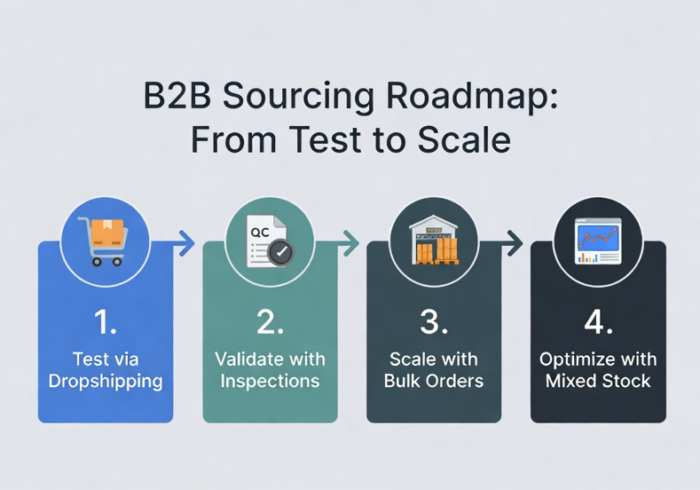
A Practical Packaging Roadmap for New Brands
Many sellers make the mistake of investing heavily in premium packaging before they know whether a product will sell consistently. A staged rollout offers a safer alternative.
Stage 1: Validate the Product
At the beginning, use reliable stock packaging with simple branding.
Recommended setup:
– Neutral protective mailer or carton
– Logo sticker
– Thank-you card
– Product instruction card
– QR code for support or repeat purchase
– Branded digital order confirmation
This keeps packaging inventory manageable while creating a more polished delivery experience.
Stage 2: Add Brand Recognition
Once sales are stable, add packaging components that customers will recognize immediately.
Recommended additions:
– Custom tissue paper
– Branded tape
– Printed mailers
– Custom product labels
– Seasonal insert cards
– Branded pouch or sleeve
At this stage, you should also collect customer feedback. Ask whether the package arrived undamaged, whether the instructions were useful, and whether the presentation matched expectations.
Stage 3: Build a Premium Unboxing Experience
When you have repeat demand and clearer customer lifetime value, consider fully customized packaging.
Recommended upgrades:
– Printed corrugated boxes
– Retail-ready folding cartons
– Custom molded inserts
– Foil stamping or embossing
– Gift-ready packaging
– Custom-designed product manuals
– Premium rigid boxes for high-margin goods
Do not use premium packaging simply because competitors do. Use it when it supports product protection, brand positioning, price perception, repeat purchase, or a wholesale strategy.
Packaging Costs: What Sellers Often Miss
The unit price of a box is only one part of packaging cost. A lower-cost package may increase shipping charges, storage fees, breakage, labor time, or return risk.
Evaluate the total landed packaging cost.
| Cost Area | What to Review | Why It Matters |
| Packaging unit price | Cost per box, mailer, insert, or label | Determines direct cost per order |
| Minimum order quantity | Required volume for customized items | Affects upfront cash commitment |
| Storage | Space used by cartons and packaging materials | Large boxes consume warehouse capacity |
| Weight | Actual and dimensional weight | Can increase shipping expense |
| Labor | Extra packing, assembly, and kitting time | Complex packaging costs more to fulfill |
| Damage prevention | Protection against crushing, moisture, or movement | Can reduce refunds and replacement costs |
| Rework risk | Artwork corrections, poor print quality, wrong dimensions | Can delay launches and waste inventory |
| Disposal and sustainability | Material selection and customer perception | Influences brand experience and packaging decisions |
Sustainable packaging is also becoming more commercially relevant across ecommerce and retail. One market analysis estimates the global sustainable packaging market at USD 325.94 billion in 2026, with ecommerce and retail among the faster-growing end-user segments.
That does not mean every brand should immediately switch to every available eco-material. It means sellers should evaluate materials based on durability, recyclability, customer expectations, cost, and the waste created by damaged shipments.
How Looperbuy Can Support Custom Packaging Dropshipping
Looperbuy can serve as a practical bridge between Chinese suppliers and global B2B sellers that want to reduce inventory exposure and fulfillment complexity.
Instead of coordinating separate product factories, packaging suppliers, warehouse staff, and international shipping providers, sellers can build a more centralized process around sourcing, storage, order fulfillment, and direct dispatch.
For brands that need custom packaging, the operational goal should be simple:
Source the right product, apply the right brand materials, verify the finished order, and send it to the customer with minimal friction.
A coordinated fulfillment model can be particularly useful when you need to:
– Source products from multiple Chinese manufacturers
– Combine several items into one order
– Add custom inserts, labels, and branded packaging
– Store packaging materials separately from products
– Ship orders to customers in different countries
– Test a new private label product without purchasing excessive stock
– Improve consistency across marketplace, direct-to-consumer, and wholesale orders
Private label dropshipping is increasingly used by sellers who want more brand control while avoiding the traditional inventory burden of buying and storing large product volumes upfront. Shopify’s current guide emphasizes product selection, supplier evaluation, and fulfillment automation as central elements of this model.
Common Mistakes to Avoid
Choosing Packaging Before Product Testing
A beautiful custom box can become dead stock if the product is changed, discontinued, resized, or fails to gain traction.
Start with flexible components before committing to highly specific packaging.
Ignoring Box Dimensions
Even a small increase in parcel size can affect storage, handling, and shipping pricing. Confirm external dimensions, internal dimensions, and protective void fill requirements.
Sending Artwork Without a Packaging Specification
A logo file alone is not enough.
Provide:
– Artwork format
– Brand color references
– Placement instructions
– Print areas
– Barcode requirements
– Language requirements
– QR-code destination
– Finishing preferences
– Product-to-package matching instructions
Treating Packaging as Only a Marketing Expense
Packaging also has an operational role. It protects the product, organizes accessories, communicates product instructions, supports compliance, and reduces customer confusion.
Making Unsupported Origin Claims
Avoid using statements such as “Made in USA” or similar origin claims unless you have a clear basis for them. U.S. authorities distinguish between origin marking requirements and advertising claims, and both require careful review.
How to Start With Looperbuy
If you are evaluating dropshipping manufacturers for custom packaging, begin with a controlled pilot rather than a full-scale launch.
1. Choose one or two proven products.
2. Define your target countries and expected monthly order volume.
3. Select a basic packaging format.
4. Prepare your logo files, insert content, and packaging instructions.
5. Request sample photos or a physical sample where appropriate.
6. Create a written quality-control checklist.
7. Place a small test batch.
8. Review delivery condition, tracking quality, customer feedback, and packaging consistency.
9. Improve the packing process before expanding to more SKUs.
Ready to build a branded dropshipping operation without taking on unnecessary inventory and warehouse complexity? Contact Looperbuy to discuss product sourcing, custom packaging, quality checks, and global order fulfillment for your store or B2B sales program.
Frequently Asked Questions
1. What is custom packaging dropshipping?
Custom packaging dropshipping is a fulfillment model in which products are packed with your brand’s packaging materials—such as boxes, mailers, inserts, stickers, labels, or tissue paper—and shipped directly to the final customer.
2. Can I use custom packaging with low order volumes?
Yes. Start with lower-commitment items such as stickers, thank-you cards, labels, or inserts. Fully printed boxes often require higher minimum order quantities, so they are usually better once product sales are stable.
3. What packaging is best for dropshipping?
The best option depends on your product. Mailers work well for lightweight and soft goods. Corrugated boxes suit fragile or premium products. Inserts, stickers, and tissue paper are flexible choices for early-stage brands.
4. Should I use a manufacturer or a sourcing agent for private label packaging?
A direct manufacturer can be ideal for a single specialized product. A sourcing and fulfillment partner can be more suitable when you need to combine products from multiple suppliers, add packaging components, store inventory, and send individual orders worldwide.
5. How can I prevent packaging mistakes?
Use approved artwork files, request a proof or sample, define packing rules in writing, and create a final inspection checklist. Confirm logo placement, colors, package dimensions, inserts, labels, and SKU matching before production.
6. Can a dropshipping supplier store my branded packaging?
Many fulfillment providers can store packaging components and use them as orders are fulfilled. Confirm storage terms, inventory tracking, replenishment lead times, and whether the warehouse can apply different packaging rules to different products.
7. Is sustainable packaging always more expensive?
Not always. Some sustainable materials may cost more per unit, while lightweight paper-based options or right-sized packaging can reduce shipping expense and product damage. Compare total cost, not only the cost of the packaging material.
8. Do imported products need country-of-origin labels?
Requirements depend on the destination and product category. For products entering the United States, foreign-origin articles generally require country-of-origin marking unless an exception applies. Review labeling needs before production and shipping.
References
1. Shopify. “[Private Label Dropshipping: 2026 Guide + Top Suppliers].”
2. Shopify. “[Product Packaging Design: Guide for Ecommerce].”
3. U.S. Customs and Border Protection. “[Marking of Country of Origin on U.S. Imports].”
4. Mordor Intelligence. “[Sustainable Packaging Market Size, Drivers & Opportunities].”
5. Schneider Wallace Cottrell Kim LLP. “[Made in the USA Labeling Laws].”