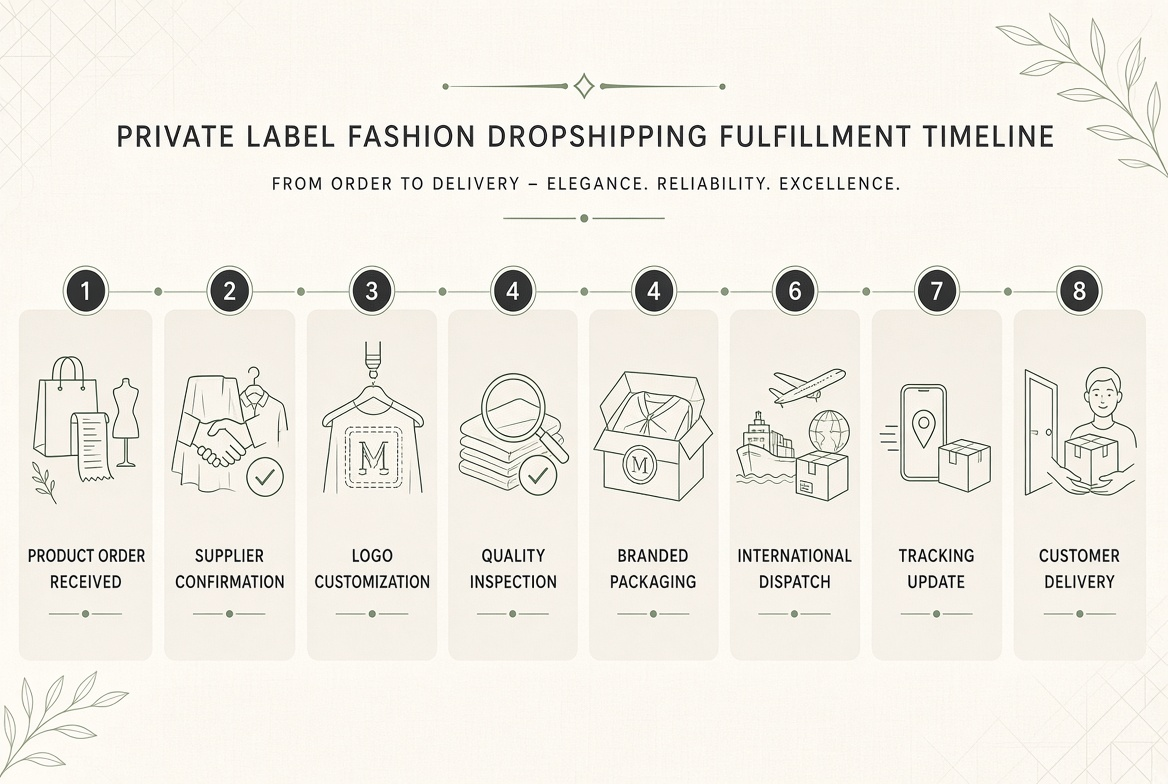
Private label dropshipping can help fashion brands launch branded products without heavy inventory investment, but success depends on more than adding a logo. Learn the most common mistakes involving supplier selection, samples, sizing, quality control, delivery promises, compliance, and scaling—plus practical ways to build a dependable fashion fulfillment process.
Private label dropshipping gives fashion brands a practical way to launch branded apparel, accessories, and lifestyle products without buying large amounts of inventory upfront. Instead of holding stock, your store sells products under your own identity while a sourcing and fulfillment partner manages supplier coordination, quality checks, packaging, and delivery.
But private label dropshipping for fashion brands is not simply about adding a logo to a generic product. In fashion, customers judge your business through fabric feel, fit consistency, color accuracy, packaging, delivery experience, and how you handle returns. A weak process can quickly turn a promising brand into a stream of refunds, chargebacks, and negative reviews.
At Looperbuy, we see a common pattern: the brands that scale do not necessarily start with the biggest catalog or the lowest supplier price. They start with a clear product standard, realistic fulfillment expectations, and a repeatable quality-control process.
> Key principle: In fashion dropshipping, your supplier’s execution becomes part of your brand identity.
Table of Contents
What Is Private Label Dropshipping in Fashion?
Private label dropshipping is a retail model in which a seller markets products under its own brand, while a third-party supplier or sourcing partner produces, stores, packs, or ships the goods directly to the customer.
For a fashion business, private labeling can include:
– Custom neck labels, hangtags, care labels, and size labels
– Branded polybags, tissue paper, mailers, boxes, and thank-you cards
– Custom embroidery, printing, patches, or logo placement
– Curated product collections under a distinct brand concept
– Branded order inserts and post-purchase messaging
– Product photography and descriptions designed around your target customer
Private label dropshipping is different from traditional reselling. The objective is not only to find products that already sell. It is to create a consistent customer experience that customers can recognize, trust, and return to.
The opportunity remains substantial. U.S. e-commerce accounted for 16.4% of total retail sales in the second quarter of 2026, according to the U.S. Census Bureau. That continuing shift toward online shopping creates room for focused apparel brands, but it also raises the standard for product accuracy, shipping reliability, and customer service.
Why Fashion Brands Face Higher Risk
Fashion is a visually led category, but it is also one of the most operationally demanding categories to sell online. A shopper may accept a small difference in the shade of a phone case. They are far less likely to accept a dress that fits differently from the size chart, trousers that feel thinner than expected, or a branded hoodie with a crooked printed logo.
Returns are a major commercial issue. The National Retail Federation estimated that 19.3% of online sales would be returned in 2025, while 82% of consumers said free returns matter when they shop. For fashion brands, poor fit, inconsistent sizing, inaccurate images, and unexpected fabric quality can make return exposure even more serious.
The fashion-specific challenge
| Customer expectation | What can go wrong | Brand impact |
| Accurate fit | Supplier sizing varies by style or factory | Returns, exchanges, poor reviews |
| Premium feel | Fabric weight, stretch, or finishing differs from samples | Lost trust and repeat purchases |
| Correct color | Photography, dye lots, and screens create mismatches | “Not as described” complaints |
| Fast delivery | Production or dispatch timelines are unclear | Cancellations and chargebacks |
| Branded unboxing | Generic bags, invoices, or inconsistent inserts are used | Weak brand recognition |
| Safe, compliant products | Labels or documentation are incomplete | Marketplace restrictions and legal exposure |
The solution is not to avoid fashion dropshipping. It is to treat it as a controlled supply-chain operation—not a hands-off shortcut.
Mistake 1: Choosing Products Before Defining a Brand Position
Many new founders begin with a supplier catalog. They browse hundreds of trending items, select a mixture of dresses, activewear, handbags, jewelry, and accessories, then hope paid ads will identify the winners.
This often creates a store that looks like a marketplace rather than a brand.
A better starting point is to define a clear customer and a clear promise. For example:
– Minimalist workwear for women who want polished, easy-care outfits
– Oversized streetwear for a specific age group and aesthetic
– Gym-to-street activewear with inclusive size guidance
– Travel-friendly resort clothing with lightweight fabrics
– Modest fashion basics with carefully explained coverage and fit
Your product selection should support that promise. Your fabric choices, colors, packaging, model photography, price point, and delivery message should reinforce it.
A practical product-selection filter
Before adding a product, ask:
1. Does it fit our brand’s visual and functional identity?
2. Can we explain why this item is better than a generic alternative?
3. Is the fabric, construction, and finish consistent with our target price?
4. Can we obtain accurate measurements and test samples?
5. Can the item be replenished reliably if it performs well?
6. Can it be packed and shipped without excessive damage or size-related returns?
Expert insight: Start with a narrow “hero collection.” A focused launch of 8–20 well-tested SKUs is usually easier to manage than a catalog of 100 unverified products.
Mistake 2: Selecting the Cheapest Supplier Instead of the Best-Fit Partner
The lowest unit cost is not the lowest total cost.
A supplier offering a $2 lower price may create much larger losses through defects, slower dispatch, inaccurate inventory, inconsistent colors, or poor communication. In private label dropshipping, a supplier is not only a vendor. They are an extension of your product and customer-service teams.
What to evaluate beyond price
| Supplier evaluation area | Questions to ask |
| Product capability | Can the supplier consistently make this category and fabric type? |
| Minimum order requirements | What is the MOQ for labels, packaging, colors, and custom finishes? |
| Sample quality | Does the production sample match the approved sample? |
| Communication | Who responds when there is an urgent size, stock, or quality problem? |
| Lead times | How long do customization, production, packing, and dispatch actually take? |
| Inventory visibility | Can stock availability be verified before customers place orders? |
| Quality control | What is checked before shipping, and can photo evidence be provided? |
| Scalability | Can output increase during promotions or seasonal demand? |
| Backup options | Is there an approved alternative for a high-performing product? |
Do not rely solely on supplier photos, marketplace ratings, or chat promises. Request samples and inspect them as your customers will.
Sample-testing checklist for fashion products
– Measure every key point against the proposed size chart
– Wash the garment according to its care instructions
– Check shrinkage, color bleeding, pilling, and shape retention
– Inspect seams, thread trimming, zippers, buttons, hems, and lining
– Test stretch and recovery where relevant
– Review print, embroidery, label placement, and logo alignment
– Photograph the product in natural light
– Try it on different body types when possible
– Compare the product against the listing images and claims
Do not approve a product only because it looks good in a supplier video. A garment must survive use, washing, packing, and customer expectations.
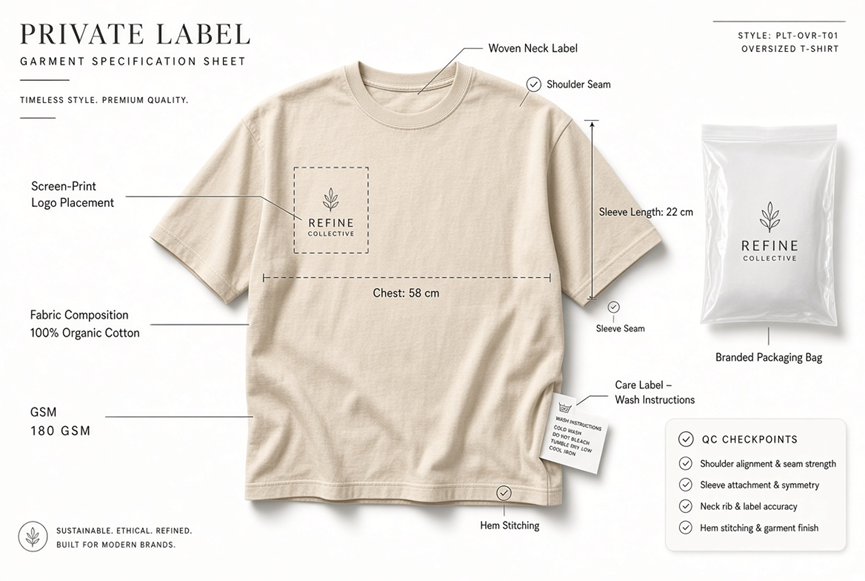
Mistake 3: Skipping a Written Product Specification Sheet
One of the most expensive mistakes in private label fashion dropshipping is assuming that “high quality,” “oversized,” “soft,” or “premium” means the same thing to everyone.
It does not.
A detailed product specification sheet turns subjective expectations into instructions that suppliers, sourcing teams, and quality-control staff can verify.
What your specification sheet should include
– Product name, SKU, and version number
– Reference photos from front, back, side, and detail views
– Fabric composition and target fabric weight
– Color references and acceptable color tolerance
– Full measurement chart with tolerances
– Stitching, seam, zipper, button, and finishing requirements
– Logo artwork, placement, dimensions, and approved print method
– Label content, size-label placement, and care-label requirements
– Packaging method and branded insert instructions
– Defect definitions and acceptable-quality threshold
– Product safety or market-specific documentation requirements
For example, “black oversized cotton T-shirt” is too vague. A production-ready instruction would specify the cotton composition, fabric weight, shoulder drop, chest measurement by size, collar rib width, print dimensions, label position, polybag requirements, and inspection points.
Mistake 4: Treating Branding as Only a Logo
A logo is important, but it is not a complete private label strategy.
A customer remembers the entire journey: the product page, sizing clarity, confirmation email, parcel tracking, packaging, garment label, product feel, and how your team resolves a problem. If your logo looks premium but the order arrives in a generic bag with an unrelated invoice, the customer experience becomes confusing.
Build a consistent brand system
Your private label dropshipping program should define:
– A recognizable color palette and product photography direction
– Brand voice for product pages, emails, and customer support
– Packaging rules for each product type
– A consistent format for care, fit, and material information
– Branded inserts that provide useful value, not just discounts
– A post-purchase communication flow that sets realistic expectations
For example, a sustainable-looking fashion brand should not make broad environmental claims just because it uses recycled-looking packaging. In the United States, advertising claims must be truthful, not deceptive or unfair, and supported by evidence.
Use precise language. If a garment contains 30% recycled polyester, say that. If only the packaging is recyclable, say that. Avoid vague claims that your supplier cannot document.
Mistake 5: Using Inaccurate Product Pages and Size Charts
Fashion shoppers cannot touch, stretch, or try on your products before purchase. Your product page must compensate for that limitation.
The most damaging product-page problem is a size chart copied from a supplier without checking whether it matches the actual garment. A second major issue is generic copy that says little about fit, fabric, or styling.
Every fashion product page should answer
– What is the garment made of?
– Is the fabric light, medium, or heavyweight?
– Is it stretchy, structured, brushed, lined, sheer, or breathable?
– Is the fit slim, regular, relaxed, oversized, cropped, or tailored?
– Does the item run small, large, or true to size?
– What measurements should the customer use?
– What size is the model wearing, and what are the model’s measurements?
– How should the customer wash and care for it?
– What color variations may occur because of screens, lighting, or dye lots?
– When will the product likely ship and arrive?
Improve fit confidence
Use garment measurements instead of only body measurements. Give shoppers a simple measuring guide and explain the tolerance range. If a product is intentionally oversized, explain that clearly and show it on more than one body type.
A clear size chart reduces uncertainty before checkout. It is often more valuable than adding another promotional banner.
Illustration suggestion: Fit and size education
Recommended placement: After this section.
AI image prompt:
*Create a premium fashion e-commerce size guide illustration. Show three diverse models wearing the same relaxed-fit hoodie in different sizes, with simple garment-measurement line indicators for chest width, body length, and sleeve length. Neutral studio backdrop, realistic fabric texture, modern direct-to-consumer clothing brand aesthetic, clean composition, 16:9.*
Mistake 6: Ignoring Quality Control Until Customers Complain
Quality control should happen before orders leave the warehouse, not after poor reviews arrive.
For fashion products, even a small defect rate can become expensive because a defect may involve product replacement, reverse logistics, customer-support time, payment fees, and reputational damage.
A practical three-stage quality process
1. Pre-production approval
Approve the final sample, specifications, colors, branding components, and packaging before bulk production or fulfillment setup.
2. In-process inspection
Check early production items for sizing, color, logo placement, stitching, and finishing before the same issue affects a larger quantity.
3. Pre-shipment inspection
Verify the correct SKU, size, color, branding, packaging, and visible product condition before dispatch.
For dropship orders, establish rules in advance. For example, your fulfillment partner may photograph all customized items before sealing the parcel, or inspect a defined percentage of standard orders and 100% of high-value products.
Track problems by SKU, supplier, defect type, destination market, and fulfillment batch. This turns complaints into usable operational data.
A simple quality dashboard
| Metric | Why it matters | Action trigger |
| Defect rate | Shows product or supplier consistency | Investigate when the rate rises above your target |
| Return reason | Identifies fit, quality, or listing problems | Update product, size chart, or copy |
| Dispatch time | Measures fulfillment reliability | Escalate recurring delay patterns |
| Wrong-item rate | Indicates picking and packing issues | Add barcode or photo-verification steps |
| Repeat purchase rate | Signals product and brand satisfaction | Scale proven categories carefully |
| Customer review themes | Reveals issues data alone may miss | Use comments in product improvement meetings |
Mistake 7: Promising Delivery Times You Cannot Control
Private label dropshipping often involves several stages: supplier availability, customization, quality inspection, packing, export processing, international transport, local delivery, and possible customs delays.
Brands damage trust when they market “fast shipping” without clearly separating processing time from transit time.
Create a transparent delivery promise
Use language such as:
– “Custom-branded items are prepared within 3–7 business days.”
– “Estimated transit time begins after dispatch.”
– “Delivery estimates vary by destination and carrier service.”
– “Tracking is sent once your parcel has been handed to the carrier.”
Do not hide long production lead times in a footer. Put the relevant information on product pages, in the cart, in the order confirmation, and in the shipping-policy page.
A transparent delivery policy does not eliminate complaints, but it reduces the surprise that creates many complaints.
Mistake 8: Forgetting Compliance, Labeling, and Claim Documentation
Fashion founders often focus on design and marketing, then discover too late that their target market requires specific labeling, product-safety information, or responsible-party arrangements.
For example, businesses selling consumer products into the European Union must account for the General Product Safety Regulation. The regulation requires an EU-based responsible person for products placed on the market by non-EU businesses, and it increases accountability for online marketplaces.
Requirements vary based on destination, product category, materials, and claims. A children’s garment, costume jewelry item, cosmetic accessory, or product marketed with a safety, sustainability, or origin claim may carry different risks than a basic adult cotton T-shirt.
Do not make unsupported origin claims
If you sell to U.S. consumers, be especially cautious with “Made in USA” or similar unqualified origin statements. The FTC says an unqualified “Made in USA” claim generally requires that final assembly or processing, significant processing, and all or virtually all ingredients or components be U.S.-made and sourced.
If your product is sourced from China, do not use U.S.-origin imagery or wording that could mislead customers about where it was made. Transparency is both safer and more credible.
Build a compliance file for each product
– Supplier identity and production location
– Material composition documentation
– Label artwork and wording
– Test reports or certifications where applicable
– Product safety information
– Care instructions
– Relevant import and destination-market documentation
– Records supporting any performance, material, environmental, or origin claim
For higher-risk categories or new markets, seek advice from a qualified compliance professional. A sourcing partner can help organize documentation, but it should not replace market-specific legal advice.
Mistake 9: Launching Too Many SKUs Before Proving Demand
A larger catalog can look impressive, but it creates more inventory uncertainty, more size charts, more supplier relationships, more customer-service variables, and more possible quality issues.
Instead, use a controlled test-and-scale approach.
The 90-day private label launch plan
| Phase | Main goal | Recommended actions |
| Days 1–30 | Validate product quality | Select a niche, order samples, build specifications, test packaging |
| Days 31–60 | Validate customer response | Launch a small collection, collect customer questions, monitor fit feedback |
| Days 61–90 | Improve and scale carefully | Refine pages, remove weak SKUs, expand proven colorways or complementary items |
A strong early signal is not only sales volume. Look for signals of product-market fit:
– Low “not as described” complaints
– Positive comments about fit and material
– A manageable return rate
– Customers purchasing more than one item
– Clear evidence that a specific silhouette, fabric, or color is working
– Repeatable supplier performance across multiple order cycles
Scale what is proven, not what is merely popular for one week.
How Looperbuy Supports Private Label Fashion Brands
A reliable sourcing and fulfillment workflow can reduce the operational friction that prevents fashion brands from growing. Looperbuy can help global B2B sellers source products from China, coordinate supplier communication, manage custom branding requirements, conduct quality checks, consolidate parcels, and arrange order fulfillment without requiring sellers to operate their own warehouse.
For fashion brands, the most useful workflow is collaborative:
1. Share your product concept, target market, and brand requirements.
2. Source products based on defined quality, price, and customization criteria.
3. Order and evaluate samples before approving a launch.
4. Confirm labels, packaging, inserts, and inspection standards in writing.
5. Start with a limited collection and track quality, delivery, and return data.
6. Improve proven SKUs before expanding your range.
The goal is not simply to ship more parcels. It is to create a dependable customer experience that gives your fashion brand room to build repeat demand.
Start With a Controlled Launch
Private label dropshipping can help fashion entrepreneurs reduce upfront inventory exposure, test products faster, and build a branded storefront without managing a warehouse alone. However, the model only works when product standards, supplier communication, fulfillment processes, and customer expectations are managed carefully.
Start small, inspect thoroughly, communicate honestly, and scale only after the data supports it.
Ready to build a more reliable private label fashion supply chain? Contact Looperbuy to discuss product sourcing, custom branding, quality inspection, and global dropshipping fulfillment for your fashion brand.
Frequently Asked Questions
1. Is private label dropshipping suitable for a new fashion brand?
Yes. It can be suitable for a new brand because it reduces the need to purchase and store large quantities of inventory. However, new brands should begin with a small, carefully tested collection rather than launching many unverified products at once.
2. What is the difference between white label and private label fashion dropshipping?
White label products are generally standardized products that multiple sellers can offer under different brand names. Private label products are more closely tailored to a specific brand, often through custom labels, packaging, product specifications, colors, materials, or design adjustments.
3. How many samples should I order before launching a fashion product?
Order enough samples to test product quality, fit, color, branding, packaging, and washing performance. For products with multiple sizes, colors, or customization options, test representative variations instead of assuming one sample reflects every version.
4. How can I reduce fashion dropshipping returns?
Reduce returns by using verified size charts, describing fabric and fit accurately, showing products on multiple models, using real product photography, disclosing processing and shipping times, and inspecting products before dispatch.
5. Can I add custom packaging to dropshipped fashion orders?
Yes. Depending on supplier and order requirements, you may be able to add branded mailers, tissue paper, boxes, stickers, thank-you cards, care cards, and inserts. Confirm minimum order quantities, storage arrangements, packing instructions, and per-order costs before launching.
6. Do I need to disclose where my fashion products are made?
Labeling and disclosure obligations vary by market and product. Brands should use accurate country-of-origin information and avoid misleading claims or imagery. For products sold internationally, confirm the applicable rules for your destination markets.
7. How long does private label fashion dropshipping take?
Timing depends on product availability, customization complexity, quality checks, packaging preparation, destination, and shipping method. Separate the production or processing timeline from transit time so customers understand when delivery estimates begin.
8. What should I ask a fashion dropshipping supplier before working with them?
Ask about fabric specifications, size consistency, customization options, sample availability, minimum order quantities, lead times, stock updates, quality-control procedures, defect handling, packaging capabilities, shipping options, and their ability to scale.
References
1. U.S. Census Bureau. “[Quarterly Retail E-Commerce Sales Report].”
2. National Retail Federation. “[2025 Retail Returns Landscape].”
3. Federal Trade Commission. “[Advertising and Marketing].”
4. Federal Trade Commission. “[Complying with the Made in USA Standard].”
5. International Trade Administration. “[EU Consumer Goods General Product Safety Regulation (GPSR)].”
6. European Commission, Directorate-General for Trade and Economic Security. “[EU’s General Product Safety Regulation: A New Era of Consumer Protection].”
7. Printful. “[Private Label Dropshipping: What It Is and What to Sell to Succeed].”