Learn how to launch and scale a profitable print on demand candle business. Compare supplier models, calculate landed costs, assess candle quality, improve packaging, meet safety expectations, build private-label collections, and fulfill custom candle orders without holding excess inventory.
Print on demand candles give online sellers a practical way to launch a branded home-fragrance business without buying large volumes of inventory upfront. Instead of investing in storage, packing teams, and fulfillment operations, sellers can source custom candles, add private-label elements, and ship orders directly to customers through a reliable fulfillment partner.
For many ecommerce entrepreneurs, candles are more than a decorative product. They are a gift, a self-care ritual, a home-accessory item, and a repeat-purchase category. The global scented candle market was estimated at USD 2.24 billion in 2024 and is projected to reach USD 3.47 billion by 2033, driven by home wellness, premium gifting, and consumers’ growing interest in personalized living spaces.
However, a candle business can fail quickly if product quality, packaging, safety labels, shipping protection, or supplier communication are overlooked. This guide explains how to choose a print on demand candle supplier, compare sourcing models, protect your margins, and build a candle brand that can grow beyond one product.
> Key takeaway: The best print on demand candle supplier is not necessarily the one with the lowest unit price. It is the partner that can consistently deliver the product quality, customization, production speed, and fulfillment support your brand promises.
Table of Contents
Why Print on Demand Candles Are Worth Selling
Candles fit naturally into several high-value ecommerce categories:
– Home décor
– Wellness and self-care
– Seasonal gifting
– Wedding and event favors
– Subscription boxes
– Personalized gifts
– Corporate gifting
– Spiritual and lifestyle products
Unlike trend-driven apparel, a well-positioned candle can remain relevant throughout the year. A “Sunday Reset” lavender candle, for example, can appeal to customers looking for calm, a thoughtful gift, or an aesthetic addition to their bedroom.
The category also supports storytelling. Sellers can build collections around emotions, places, seasons, or customer identities:
– “Quiet Morning” coffee and vanilla candle
– “Coastal Escape” sea salt and driftwood candle
– “New Home” housewarming gift candle
– “Bookstore After Rain” woody literary candle
– “Focus Mode” citrus and rosemary workspace candle
This gives sellers more room to create a memorable brand instead of competing only on product price.
Candle Market Opportunity at a Glance
| Market signal | What it means for sellers |
| In 2025, the global scented candle market was worth approximately $2.3 billion, and it is projected to grow to $2.4 billion in 2026. | Scented candles are gradually moving beyond traditional holiday and gift-giving consumption, integrating into everyday home ambiance, relaxation, and self-care settings. |
| In 2025, premium scented candles accounted for approximately 71.8% of the global market share, continuing to dominate. | Consumers are increasingly willing to pay a premium for high-quality ingredients, complex fragrances, exquisite designs, and premium gift packaging. |
| In 2025, container-packaged scented candles accounted for approximately 57.7% of the market share, remaining the largest product type. | Glass jars, ceramic jars, and other containers not only serve as home décor and gift-giving gifts but are also ideal for brands to build a high-end visual image and conduct online sales. |
| Online candle sales are projected to grow as brands use visual content and product storytelling | Strong product pages, imagery, and packaging can increase conversion potential |
Market figures and category trends show that consumers increasingly view scented candles as lifestyle products rather than simple household items.
What Makes a Good Print on Demand Candle Supplier?
A custom candle supplier affects your brand reputation long after the order is placed. Customers may forgive a delayed T-shirt. They are less likely to forgive a candle that arrives cracked, smells weak, tunnels after the first burn, or has a crooked label.
When assessing a print on demand candle supplier, review five essential areas.
1. Candle Quality and Material Transparency
Ask suppliers detailed questions about the product itself. Avoid relying only on catalog images or generic descriptions such as “high-quality wax.”
Request clear information on:
– Wax type: soy, paraffin, beeswax, coconut wax, or blends
– Fragrance oil type and scent options
– Wick material and wick sizing
– Net weight and jar dimensions
– Expected burn time
– Scent throw expectations
– Vessel material, thickness, and heat resistance
– Manufacturing location
– Quality-control procedures
Wax type matters, but it should not be treated as the only quality indicator. A soy wax candle with poor wick selection or weak fragrance load can still perform badly. Likewise, paraffin remains a large segment of the global scented-candle market because it is cost-effective, easy to mold, and can carry fragrance effectively.
The right decision depends on your positioning:
| Brand position | Suitable candle direction |
| Entry-level gift store | Affordable container candle with a simple branded label |
| Wellness-focused brand | Soy or plant-based wax, calming fragrance profile, minimalist packaging |
| Premium home-fragrance brand | Layered fragrance notes, distinctive vessel, gift-ready box |
| Eco-conscious lifestyle store | Reusable jar, recyclable outer packaging, transparent material details |
| Event and wedding business | Small-format candles with personalized labels and low minimum order flexibility |
2. Customization That Builds a Real Brand
Many sellers confuse custom labeling with complete product differentiation. A logo sticker on a generic candle can be a good starting point, but it is not enough to create long-term brand value.
Look for customization options at different levels:
| Customization level | Typical options | Best use case |
| Basic | Label design, logo, product name | Product testing and low-risk launch |
| Intermediate | Label finish, lid color, scent selection, insert cards | Branded gift collections |
| Advanced | Custom vessel, custom fragrance, branded box, inserts | Established premium brands |
| Full private label | Unique formula, proprietary packaging, custom molds | Larger-volume brand expansion |
Start with a simple product test, but plan for differentiation early. Your future advantage may come from better packaging, a recognizable scent collection, or a customer experience that feels more thoughtful than generic marketplace listings.
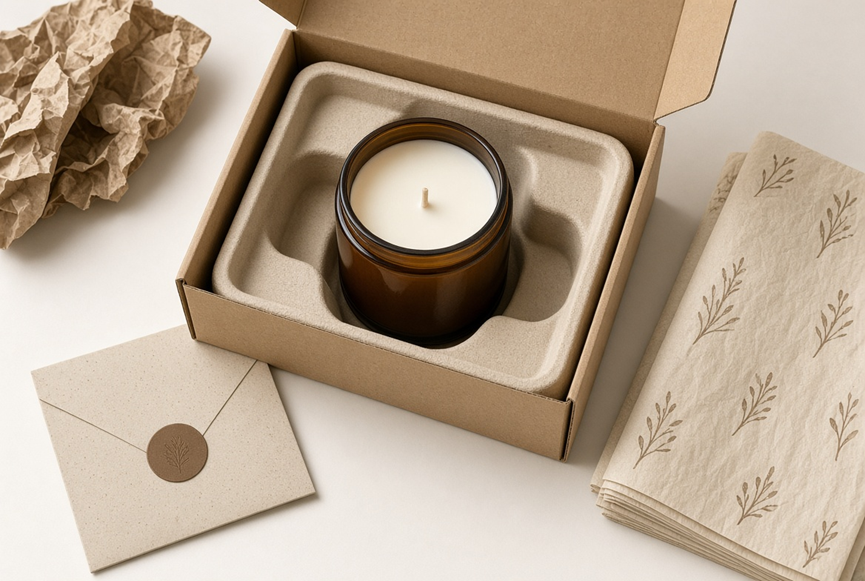
3. Packaging and Shipping Protection
Candles are fragile, heavy, and often heat-sensitive. A supplier may produce a beautiful candle, but poor packing can create breakage, melted wax, scratched jars, or unboxing disappointment.
Before selecting a supplier, order samples to evaluate:
– Outer carton strength
– Bubble wrap, molded inserts, or protective sleeves
– Lid security
– Label adhesion
– Jar stability
– Box presentation
– Damage after transit
– Shipping label accuracy
– Whether the candle looks gift-ready on arrival
A sample order is not optional for a serious candle business. It is one of the lowest-cost ways to prevent refunds, chargebacks, and negative reviews.
4. Production Time, Fulfillment, and Customer Support
Your supplier’s operations become part of your customer experience. Review their standard production time, order-processing workflow, tracking availability, damaged-order policy, and support response time.
Ask these questions before launching:
1. What is the average production time for a custom candle order?
2. What happens during peak seasons such as Black Friday, Christmas, or Mother’s Day?
3. Can the supplier provide tracking numbers automatically?
4. Who handles damaged or incorrect orders?
5. Can the supplier ship without its own branding?
6. Can orders be fulfilled to your key markets?
7. Does the supplier offer photos or videos of finished products before bulk dispatch?
For sellers working with suppliers in China, a sourcing and fulfillment platform can reduce operational friction by consolidating supplier communication, quality checks, packaging requirements, storage decisions, and international shipping support.
Print on Demand Candle Platforms vs. China Sourcing
| Sourcing model | Strengths | Watch-outs | Best for |
| Print-on-demand marketplace | Fast setup, ecommerce integrations, no bulk purchasing | Product choices and quality can vary by production partner | New sellers validating designs |
| Fulfillment-led POD provider | Streamlined workflow and more consistent fulfillment processes | Higher product and shipping costs may pressure margins | Sellers prioritizing convenience |
| Specialist candle manufacturer | Deeper fragrance, vessel, and packaging customization | Often higher MOQ or fewer integrations | Premium candle brands |
| Broad dropshipping marketplace | Easy catalog expansion into related products | Less control if supplier selection is not carefully managed | Lifestyle stores testing multiple categories |
| China sourcing and fulfillment partner | Flexible supplier access, private labeling, cost control, product bundling | Requires sample testing and clear specifications | Sellers building scalable brands |
A platform such as Looperbuy can be especially useful when your store needs more than one standard candle listing. Instead of treating candles as a single isolated product, you can source related home-fragrance and gifting products from China, coordinate custom packaging, and arrange fulfillment without holding large quantities of stock yourself.
For example, a seller may begin with three themed candles. Once customer demand is proven, they can expand into:
– Reed diffusers
– Wax melts
– Match jars
– Candle accessories
– Gift boxes
– Ceramic trays
– Room sprays
– Seasonal bundles
This approach turns a candle store into a broader home-fragrance brand while keeping inventory exposure manageable.
How to Calculate Candle Profit Before Launching
A candle that looks profitable at first can become unprofitable after shipping, packaging, payment fees, customer support, and replacement orders. Before publishing product listings, calculate your realistic landed cost.
Use this formula:
Landed Cost=Product Cost+Custom Packaging+Supplier Handling+Shipping+Payment Fees+Expected Replacement Cost
Then calculate gross margin:
Gross Margin=(Selling Price−Landed Cost)÷Selling Price×100
Example: A Branded Candle Order
| Cost item | Example cost |
| Candle product cost | USD 7.50 |
| Custom label and insert card | USD 1.20 |
| Protective packaging | USD 0.80 |
| International fulfillment | USD 6.50 |
| Payment and store fees | USD 2.00 |
| Allowance for replacements | USD 1.00 |
| Total landed cost | USD 19.00 |
| Retail price | USD 34.00 |
| Gross margin before advertising | 44.1% |
This does not mean every candle should sell for USD 34. Pricing depends on size, positioning, market, and shipping destination. The lesson is simple: do not price from the factory quote alone.
A practical rule is to create three pricing scenarios before launch:
– Best-case scenario: low shipping cost and few support issues
– Expected scenario: average shipping cost and normal refund rate
– Stress-test scenario: higher shipping costs, damaged items, or discounting
If your business works only in the best-case scenario, it is not ready to scale.
Product Safety and Labeling Cannot Be an Afterthought
Candles involve an open flame. Product safety is therefore not merely a legal or operational matter; it is central to customer trust.
In the United States, candle-related safety standards include ASTM F-2058 for fire-safety labeling, ASTM F-2179 for glass candle containers, and ASTM F-2417 for candle fire-safety design. The National Candle Association explains that ASTM F-2058 covers cautionary labeling such as burning candles within sight, keeping them away from flammable items, and keeping them away from children.
Your product page, packaging, and insert card should include appropriate safety instructions for the markets you serve. Do not copy safety claims from another brand without confirming that your own product and packaging meet relevant requirements.
At a minimum, communicate practical usage guidance:
– Burn candles within sight
– Keep candles away from flammable materials
– Keep candles away from children and pets
– Use a stable, heat-resistant surface
– Trim wicks before lighting when applicable
– Do not burn candles in bedrooms or sleeping areas
– Extinguish the flame before leaving the room or going to sleep
The U.S. Fire Administration reports that an average of 20 home candle fires are reported each day and recommends keeping lit candles at least 12 inches away from anything that can burn.
> Important: For cross-border selling, confirm the labeling, material, packaging, safety-testing, and consumer-product requirements for each destination market. This article is operational guidance, not legal advice.
A Practical Launch Plan for Custom Candle Dropshipping
Launching with too many scents and products can drain your budget and make inventory coordination difficult. A smaller, controlled launch produces clearer data.
Step 1: Choose One Customer Occasion
Start with one specific buyer need rather than “selling candles to everyone.”
Examples:
– Housewarming gifts
– Bridesmaid or wedding favors
– Self-care gifts for women
– Cozy fall home décor
– Book-lover gifts
– Corporate appreciation gifts
– Meditation and relaxation products
A clear audience makes product naming, imagery, bundles, and advertising much easier.
Step 2: Build a Focused Three-Scent Collection
A simple starting collection could include:
– One calming scent
– One fresh or energizing scent
– One warm or comforting scent
For example:
| Collection name | Fragrance direction | Customer moment |
| Reset | Lavender, eucalyptus, soft musk | Evening wind-down |
| Bright Start | Lemon, bergamot, rosemary | Morning routines and gifting |
| Slow Sunday | Vanilla, sandalwood, amber | Cozy home atmosphere |
Step 3: Order and Review Samples
Evaluate the candle as your customer would. Check scent strength, label alignment, jar quality, packaging, unboxing appeal, and shipping durability.
Record the results in a supplier scorecard. Do not rely on memory or informal chat messages.
Step 4: Create Product Pages That Answer Buyer Questions
A strong candle product page should clearly show:
– Wax type
– Net weight
– Approximate burn time
– Fragrance notes
– Vessel material
– Dimensions
– Safety guidance
– Processing time
– Estimated delivery time
– Gift packaging availability
– Return or replacement policy
Use lifestyle images to sell the feeling, but use specifications to reduce hesitation and post-purchase confusion.
Step 5: Test Bundles Before Expanding
Bundles can raise average order value while giving shoppers an easy gifting solution.
Examples:
– Candle + match jar
– Candle + ceramic tray
– Two-candle seasonal gift set
– Candle + reed diffuser
– Candle + greeting card
– Candle + cozy home blanket
Looperbuy can support this expansion model by helping sellers source complementary products, coordinate packaging requirements, and fulfill mixed-product orders without requiring the seller to manage separate supplier relationships for every item.
Final Recommendation: Build for Repeat Purchases, Not One-Time Sales
The strongest print on demand candle businesses do not depend on a single attractive label. They deliver a consistent product, a clear emotional promise, safe usage information, reliable shipping, and a reason for customers to return.
Start small. Test samples. Measure your real landed cost. Choose a supplier that can meet your quality expectations. Then build out a home-fragrance ecosystem through gift sets, seasonal editions, accessories, and complementary products.
Ready to turn your candle concept into a product line? Explore Looperbuy’s China sourcing and fulfillment services to source custom candles, add private-label packaging, test related home-fragrance products, and ship orders directly to customers without carrying unnecessary inventory.
Frequently Asked Questions
1. Is print on demand candle dropshipping profitable?
It can be profitable when sellers control product costs, shipping expenses, packaging, and customer-service risk. Profitability depends on the real landed cost rather than the candle’s factory price alone. Premium positioning, gifting bundles, and repeat-purchase collections can improve average order value.
2. What is the best wax for custom candles?
There is no single best wax for every brand. Soy, beeswax, coconut blends, paraffin, and blended waxes each have different performance, cost, fragrance, and positioning advantages. The best choice depends on your target customer, scent requirements, price point, and brand promise.
3. Should I order candle samples before selling online?
Yes. Samples are essential for checking fragrance quality, burn behavior, vessel durability, label placement, packaging quality, and shipping protection. A supplier catalog cannot show how a product performs after delivery.
4. Can I add my own logo to dropshipping candles?
Yes. Many suppliers offer basic private-label options such as custom labels, branded inserts, or logo stickers. More established brands may also request custom boxes, lid colors, fragrance blends, or candle vessels, depending on minimum order requirements.
5. What safety warnings should a candle include?
Candle sellers should use appropriate safety guidance and confirm applicable requirements for their target markets. Common instructions include burning candles within sight, keeping them away from flammable objects, keeping them away from children and pets, and placing them on a stable, heat-resistant surface. ASTM F-2058 addresses candle fire-safety labeling in the United States.
6. How can I reduce candle breakage during international shipping?
Use durable containers, protective inserts, reinforced outer cartons, secure lids, and sample-tested packaging. Ask your supplier to document its packing process and clarify its policy for damaged orders. Avoid launching at scale until the packaging has passed real shipping tests.
7. Can I sell candles and other home-fragrance products from one store?
Yes. Expanding into reed diffusers, wax melts, room sprays, match jars, decorative trays, and gift boxes can help create a more complete home-fragrance brand. A sourcing and fulfillment partner can make this easier by coordinating multiple products and suppliers.
References
1. Doba. “Print on Demand Candles Compared: Best Platforms & Quality for Dropshippers.” Available at: [https://www.doba.com/blog/marketing-and-sales-growth/marketing-tips/print-on-demand-candles-compared-best-platforms–quality-for-dropshippers-38426]
2. Grand View Research. “Scented Candles Market Size, Share & Trends Analysis Report, 2025–2033.” Available at: [https://www.grandviewresearch.com/industry-analysis/scented-candles-market]
3. National Candle Association. “Understanding Candle Safety Standards.” Available at: [https://candles.org/understanding-safety-standards/]
4. U.S. Fire Administration. “Candle Fire Safety.” Available at: [https://www.usfa.fema.gov/prevention/home-fires/prevent-fires/candle/]
5. ASTM International. “Candle Standards and Safety Specifications.” Referenced through the National Candle Association’s summary of ASTM F-2058, ASTM F-2179, ASTM F-2417, and ASTM F-2601. Available at: [https://candles.org/understanding-safety-standards/]