As a B2B sourcing and supply chain strategist with over 15 years of experience helping food manufacturers, retailers, and wholesale distributors source high-quality frozen produce from China, I’ve encountered the same question repeatedly from clients across the globe: Does freezing fruit destroy nutrients?
It’s a fair question. The instinct to equate “fresh” with “superior” runs deep in food industry decision-making. But when you peel back the science, the answer is far more nuanced—and, for B2B buyers, it has profound implications for supply chain strategy, inventory management, and product development.
In this 2026 guide, I’ll break down what the latest peer-reviewed research actually says about freezing fruit and nutrient retention, the hidden factors that affect nutritional quality (freezing method, storage duration, temperature fluctuations), and how to make smarter sourcing decisions for your business.
Table of Contents
The Short Answer: No—Freezing Fruit Preserves Nutrients Remarkably Well
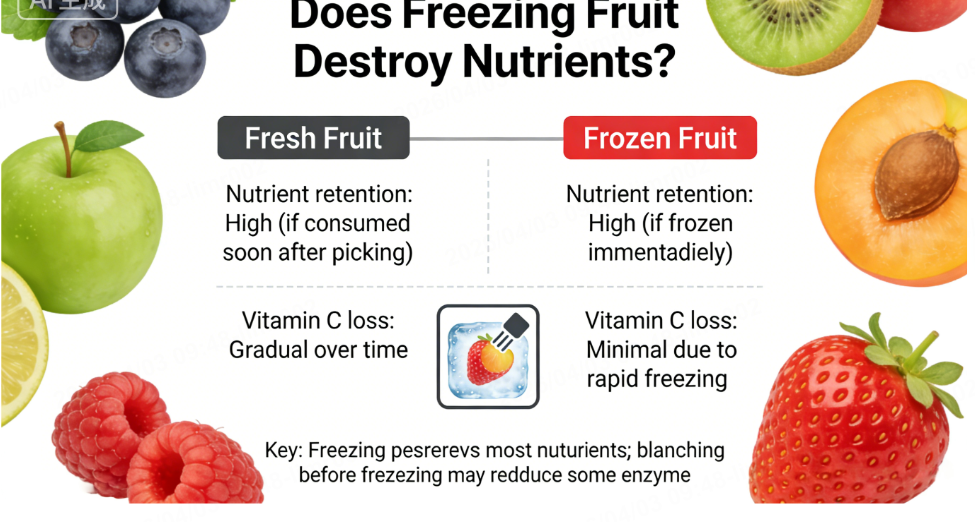
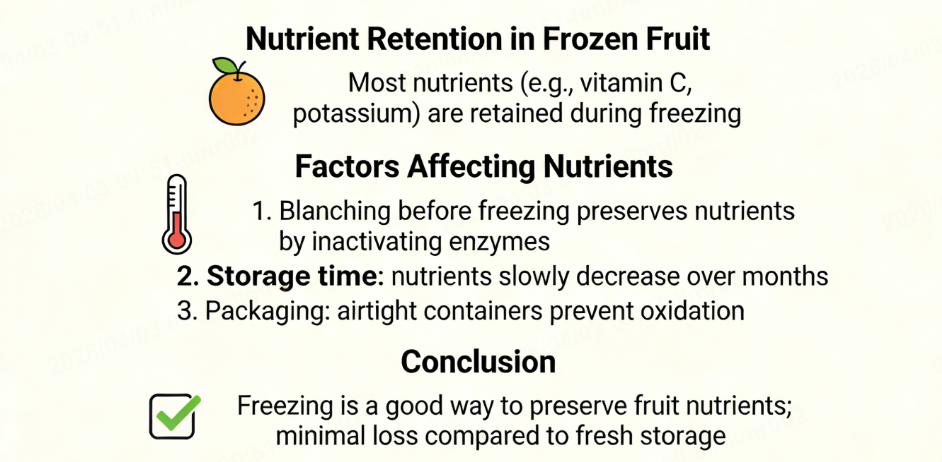
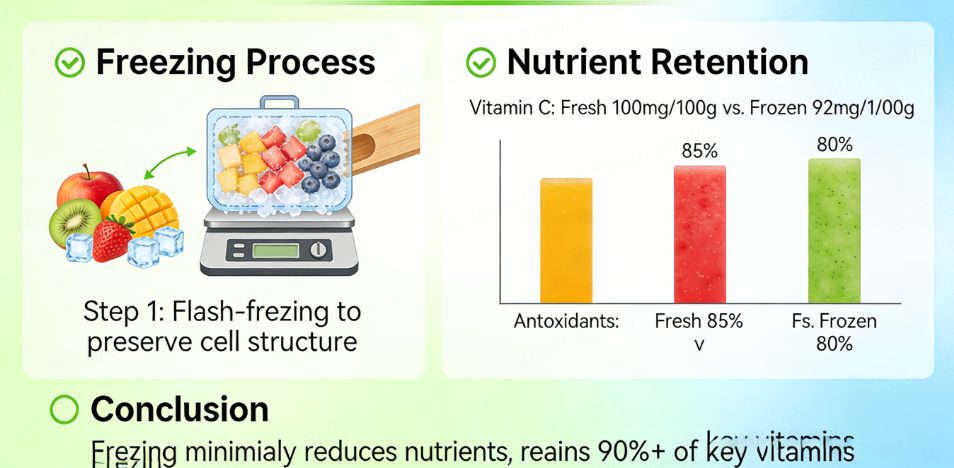
Let’s address the headline question directly. Does freezing fruit destroy nutrients? The scientific consensus from multiple peer-reviewed studies is clear: no, freezing does not destroy nutrients. In fact, frozen fruit often retains equal or higher levels of certain vitamins and antioxidants compared to fresh produce that has been stored for several days.
A landmark 2015 study published in the Journal of Agricultural and Food Chemistry analyzed four vitamins (ascorbic acid, riboflavin, α-tocopherol, and β-carotene) across eight fruits and vegetables, comparing refrigerated fresh samples against frozen counterparts at three storage intervals[reference:0]. The findings were striking: ascorbic acid (vitamin C) showed no significant difference in five of the eight commodities and was actually higher in frozen samples for the remaining three[reference:1]. Riboflavin and α-tocopherol likewise showed no meaningful differences, with three commodities recording higher α-tocopherol levels in frozen samples[reference:2].
Key takeaway from the study: “Overall, the vitamin content of the frozen commodities was comparable to and occasionally higher than that of their fresh counterparts.”[reference:3]
A 2025 Chinese-language review on frozen produce corroborates these findings. Research cited in that analysis showed that quick-frozen corn, carrots, and seven other vegetables exhibited no significant difference in vitamins B2, C, and E compared to their fresh equivalents. Notably, frozen edamame contained more vitamin C than fresh samples—17.8 mg per 100g versus 12.6 mg per 100g[reference:4].
What the Research Actually Shows: A Nutrient-by-Nutrient Breakdown
To fully answer does freezing fruit destroy nutrients, we need to examine specific nutrient categories individually. Different nutrients respond differently to the freezing process and subsequent frozen storage.
Vitamin C (Ascorbic Acid) – The most heat- and oxygen-sensitive vitamin. Studies show that immediately after freezing, vitamin C loss is minimal (typically under 10%). However, during extended frozen storage (beyond 6–8 months), gradual degradation occurs. A study on frozen apricots found that after 3 months of frozen storage, vitamin C decreased by 29%—but remained 2,375% higher than fresh apricots stored at room temperature for the same period[reference:5]. For raspberries stored at -20°C for 12 months, vitamin C decreases of 33–55% were recorded[reference:6].
Polyphenols and Antioxidants – These compounds are generally well-preserved by freezing. A study on frozen blueberries stored at glassy-state temperatures (below -50°C) exhibited the best quality retention, with minimal degradation of nutrient contents and cell integrity[reference:7]. Research on IQF (Individually Quick Frozen) berries found that frozen storage up to 4 months caused no significant loss of bioactive compounds[reference:8].
Anthocyanins – Responsible for red, purple, and blue pigments in berries. Studies show anthocyanin retention rates of 80–91% even after 10 months of frozen storage[reference:9].
β-Carotene – The one nutrient category where frozen produce consistently underperforms fresh. Multiple studies confirm that β-carotene decreases significantly in some frozen commodities—peas, carrots, and spinach all showed lower levels in frozen samples, likely due to blanching-related degradation[reference:10].
The Real Enemy Isn’t Freezing—It’s Time and Temperature Fluctuation
When B2B buyers ask does freezing fruit destroy nutrients, the more accurate question is: does poor freezing practice destroy nutrients?
Three factors determine nutritional quality in frozen fruit:
Time from harvest to freezing – Frozen fruit processed within hours of harvest locks in nutrients at their peak. Fresh fruit sitting in a warehouse or on a supermarket shelf for 5–7 days can lose 30% or more of its vitamin C before it ever reaches a consumer[reference:11].
Freezing method (IQF vs. slow freezing) – Individual Quick Freezing (IQF) technology uses ultra-low temperatures (-35°C to -40°C) to freeze each piece individually in seconds, forming tiny ice crystals that minimize cell damage. Slow freezing (typical home freezer) creates large ice crystals that rupture cell walls, leading to nutrient loss upon thawing.
Storage temperature stability – Even a perfectly frozen product degrades if subjected to temperature fluctuations. A 2025 study on frozen blueberries found that temperature changes during storage—causing the fruit to transition between glassy and rubbery states—resulted in more pronounced quality deterioration, including greater nutrient loss and cell integrity damage[reference:12]. Maintaining consistent storage temperatures below -18°C is critical.
New Section: The Science of IQF – How Commercial Freezing Protects Nutrients
For B2B buyers sourcing frozen fruit from China, understanding IQF (Individually Quick Frozen) technology is essential to answering does freezing fruit destroy nutrients for your specific supply chain.
IQF works by exposing individual fruit pieces to a blast of ultra-cold air (typically -35°C to -40°C) for a very short duration. The extreme cold freezes the water content almost instantly, forming microscopic ice crystals that do not puncture cell walls. This preserves:
Cell structure integrity – Intact cells retain their natural moisture, flavor, and nutrient content.
Texture – IQF fruit remains “individual” and free-flowing, not frozen into a solid block.
Enzyme inactivation – Rapid freezing suppresses the enzymatic activity that would otherwise degrade vitamins and antioxidants over time.
In contrast, slow freezing (such as in a standard home freezer or poorly managed commercial freezer) allows large ice crystals to form, rupturing cell membranes and causing nutrient-rich liquid to leach out during thawing. This is the primary reason why consumers sometimes perceive frozen fruit as “mushy” or less flavorful—but it’s a processing issue, not an inherent limitation of freezing as a preservation method.
Facilities with HACCP and ISO 22000 certifications typically employ proper IQF technology and maintain rigorous temperature controls throughout the cold chain[reference:13]. For B2B buyers, verifying that a supplier uses IQF equipment and maintains a documented cold chain is the single most important step in ensuring nutritional quality.
New Section: The B2B Opportunity – Frozen Fruit Market Trends and Sourcing from China
For B2B buyers, the question does freezing fruit destroy nutrients isn’t just academic—it’s a commercial decision that affects product development, cost structures, and supply chain resilience.
The global frozen fruit market reflects growing confidence in the nutritional value of frozen produce. In 2024, the market was valued at approximately $5.23 billion, with projections reaching $6.47 billion by 2031 at a compound annual growth rate of 3.1%[reference:14]. Global trade volume in 2025 is estimated to exceed 3.1 million tonnes in imports and 3.0 million tonnes in exports[reference:15].
China remains the world’s leading exporter of IQF fruits, with two provinces serving as primary production hubs. Fujian Province specializes in tropical fruits such as lychee, longan, rambutan, and mango, leveraging its coastal location and Xiamen Port for efficient distribution[reference:16]. Shandong Province focuses on temperate crops including strawberries, blueberries, apples, cherries, and peaches, with large-scale orchards and modern cold storage facilities adhering to HACCP, ISO 22000, and BRCGS standards[reference:17].
For B2B buyers sourcing from China, working with certified suppliers who maintain strict quality controls ensures that the nutritional benefits of IQF technology are fully realized.
How LooperBuy Supports Your Frozen Fruit Sourcing
At LooperBuy, we’ve built our one-stop B2B sourcing platform to connect global buyers with vetted Chinese suppliers—including IQF frozen fruit manufacturers who meet rigorous food safety and quality standards.
When you source frozen fruit from China through LooperBuy, you get:
Vetted suppliers – All frozen fruit suppliers on our platform undergo an 8-step vetting process, including certification verification (HACCP, ISO 22000, BRCGS, FDA) and facility audits.
Cold chain logistics – Integrated logistics with temperature-controlled shipping options, real-time tracking, and cold chain integrity monitoring.
Quality assurance – Pre-shipment inspections available for all orders, including temperature verification and visual quality checks.
Transparent pricing – Landed cost calculator showing all-inclusive pricing, including cold chain freight and duties.
Ready to source high-quality frozen fruit from China? [Sign up for LooperBuy] – free account, vetted suppliers, and end-to-end supply chain support.
Frequently Asked Questions (FAQ)
1. Does freezing fruit destroy nutrients compared to fresh fruit?
No. Peer-reviewed research shows that frozen fruit retains comparable—and in some cases higher—levels of vitamin C, riboflavin, α-tocopherol, and polyphenols compared to fresh produce that has been stored for several days. Vitamin C content in frozen samples was higher than fresh in three of eight commodities tested in a landmark 2015 study[reference:18].
2. Which nutrients are most affected by freezing?
β-Carotene shows the most consistent decrease in frozen samples, particularly in peas, carrots, and spinach, likely due to blanching processes before freezing[reference:19]. Vitamin C can degrade during extended frozen storage (beyond 6–8 months), with losses of 33–55% reported after 12 months in raspberries[reference:20].
3. What is IQF and why does it matter for nutrient retention?
IQF (Individually Quick Frozen) technology freezes each piece of fruit individually at ultra-low temperatures (-35°C to -40°C) within seconds. This creates microscopic ice crystals that don’t rupture cell walls, preserving texture, flavor, and nutrients far better than slow freezing methods. Commercial IQF facilities are typically HACCP and ISO 22000 certified[reference:21].
4. How long can frozen fruit be stored without significant nutrient loss?
Most frozen fruit maintains high nutritional quality for 6–8 months when stored at consistent temperatures at or below -18°C. Studies show that bioactive compounds remain largely unchanged for up to 4 months, with only gradual degradation occurring between 6 and 12 months. Blueberries show the smallest antioxidant loss (approximately 23%) after 10 months of storage[reference:22].
5. Does thawing frozen fruit cause nutrient loss?
Yes, thawing method matters significantly. Room temperature or water thawing can cause water-soluble vitamins (especially vitamin C and B vitamins) to leach out with melted ice crystals. The most nutrient-preserving methods are thawing in the refrigerator (slow thaw, minimal leaching) or cooking directly from frozen, which bypasses the thawing step entirely. Direct cooking is recommended for baked goods, smoothies, and cooked applications[reference:23].
6. Can LooperBuy help me source frozen fruit from China?
Absolutely. LooperBuy connects B2B buyers with vetted Chinese IQF frozen fruit suppliers in Shandong and Fujian provinces—the world’s leading production hubs. We verify certifications (HACCP, ISO 22000, BRCGS, FDA), facilitate quality inspections, and provide integrated cold chain logistics with real-time tracking.
Article Summary
Does freezing fruit destroy nutrients? Scientific answer from peer-reviewed research: no—frozen fruit often retains equal or higher nutrients than fresh. Includes IQF technology, market trends ($5.23B global market), and LooperBuy sourcing for B2B buyers.
Hot Tags
does freezing fruit destroy nutrients, frozen fruit nutrition facts, IQF fruit benefits, freezing vs fresh fruit vitamin retention, frozen fruit antioxidant preservation, frozen fruit shelf life nutrients, IQF technology frozen fruit, China frozen fruit export suppliers, B2B frozen fruit sourcing, LooperBuy food sourcing, cold chain logistics frozen fruit, frozen berry nutrition research 2025, frozen fruit processing nutrient loss, HACCP certified frozen fruit suppliers
References
Bouzari, A., Holstege, D., & Barrett, D. M. (2015). Vitamin retention in eight fruits and vegetables: a comparison of refrigerated and frozen storage. Journal of Agricultural and Food Chemistry, 63(3), 957–962. Retrieved from https://pubmed.ncbi.nlm.nih.gov/25526594/[reference:24]
de Ancos, B., et al. (2000). Ellagic acid, vitamin C, and total phenolic contents and radical scavenging capacity affected by freezing and frozen storage in raspberry fruit. Journal of Agricultural and Food Chemistry, 48(10), 4565–4570. Retrieved from https://pubmed.ncbi.nlm.nih.gov/11052701/[reference:25]
Adkison, E. C., et al. (2018). Effect of Canning and Freezing on the Nutritional Content of Apricots. Journal of Food Science. Retrieved from https://pubmed.ncbi.nlm.nih.gov/29786836/[reference:26]
Li, Y., Chen, L., Zheng, Z., Huang, B., & Yu, M. (2025). Effect of Freezing State Change on the Quality of Frozen Blueberry Fruits. China Food Publishing Company. Retrieved from https://agris.fao.org/search/zh/records/682f29ea9d0aa4165340ae2e[reference:27]
Poiana, M. A., Moigradean, D., Raba, D., Alda, L. M., & Popa, M. (2010). The effect of long-term frozen storage on the nutraceutical compounds, antioxidant properties and color indices of different kinds of berries. Journal of Food, Agriculture and Environment, 8(1), 54–58. Retrieved from https://www.mendeley.com/catalogue/6dc429d8-b2fe-3c54-ac3f-8801b3fd58a8/[reference:28]
冷冻蔬果真的“营养掉队”?打破你的固有认知. (2025). Retrieved from https://www.bjjubao.org.cn/2025-11/25/content_47699.html[reference:29]
QYResearch. (2025). Frozen Fruit – Global Market Share and Ranking, Overall Sales and Demand Forecast 2025-2031. Retrieved from https://www.giiresearch.com/report/qyr1861235-frozen-fruit-global-market-share-ranking-overall.html[reference:30]
JK International. (2025). Global Frozen Fruits Trade 2025 | Import, Export, Prices & Regional Trends. Retrieved from https://www.jkinternational.net/global-frozen-fruits-trade-2025-import-export-prices-and-regional-growth-trends/[reference:31]
Alibaba. (2025). IQF Fruit Supplier Sourcing Guide: Evaluate Top Global Exporters. Retrieved from https://www.alibaba.com/price-comparison/iqf-fruit-suppliers[reference:32]
Taipei International Food Show. (2026). IQF Frozen Fruits & Vegetables – ZHAN SHIAN AGRICULTURAL BIOTECHNOLOGY CO., LTD. Retrieved from https://www.foodtaipei.com.tw/en/product/CBA4659B8C39B7F70A983187C9C22560E3209A7B085CC6E3/info.html[reference:33]
LooperBuy. (2026). Supplies Business: A B2B Expert’s Guide to Sourcing Chinese Goods Globally with LooperBuy. Retrieved from https://blog.looperbuy.com/supplies-business-a-b2b-experts-guide-to-sourcing-chinese-goods-globally-with-looperbuy.html