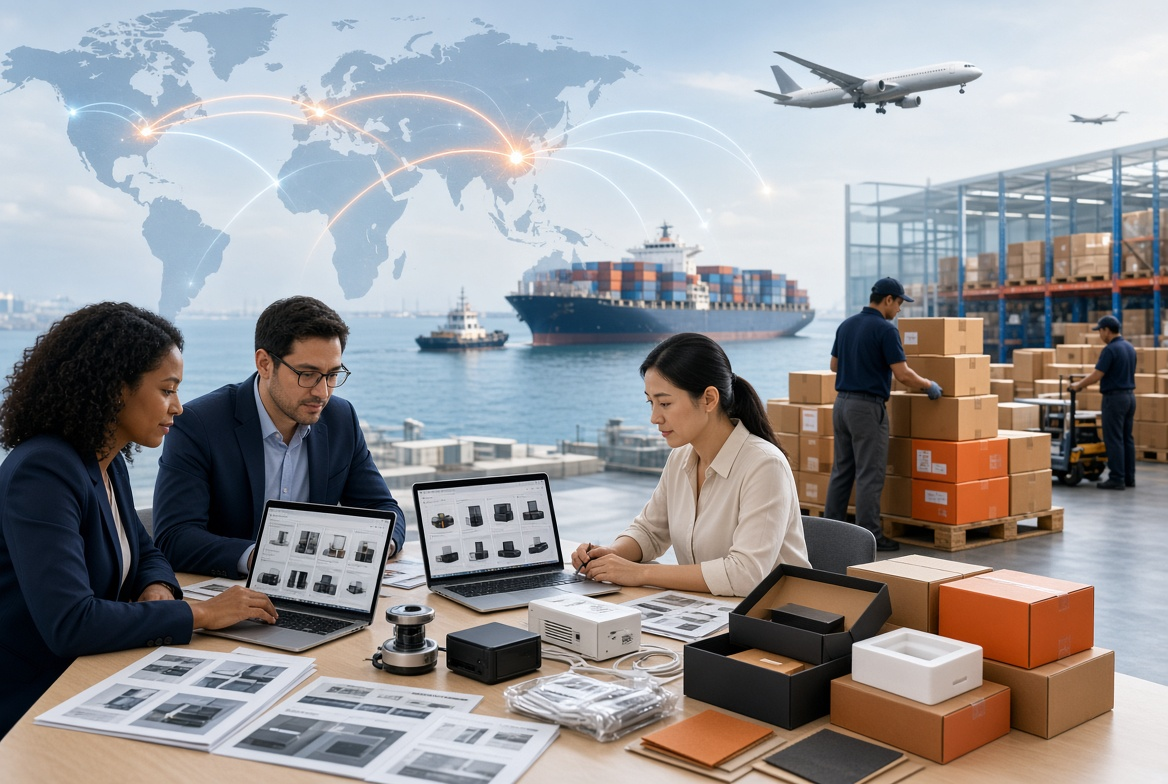
Explore the benefits and limitations of multi-vendor B2B marketplaces for global sellers sourcing from China. Learn how supplier comparison, quality inspection, consolidated shipping, and dropshipping support can help reduce inventory risk, improve fulfillment control, and build a more reliable cross-border supply chain.
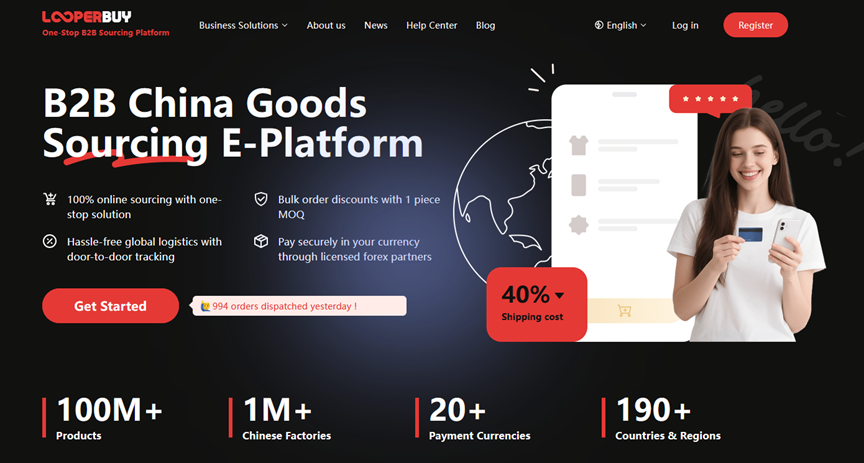
A multi-vendor B2B marketplace can help global sellers discover suppliers, compare products, consolidate procurement, and reduce the operational burden of international sourcing. However, the marketplace itself is only one part of the equation: sustainable growth depends on supplier verification, product-quality control, transparent landed-cost calculations, and dependable fulfillment after the order is placed.
For online retailers, wholesalers, distributors, and emerging brands buying from China, the strongest model is not simply “find the lowest product price.” It is a sourcing workflow that connects product discovery with purchasing support, inspection, consolidation, payment coordination, and direct fulfillment. This is where a China sourcing and dropshipping partner such as Looperbuy can help businesses operate with less inventory exposure and less day-to-day supply-chain complexity.
Table of Contents
What Is a Multi-Vendor B2B Marketplace?
A multi-vendor B2B marketplace is a digital platform where multiple suppliers sell products or services to multiple business buyers. Instead of purchasing from one brand-owned store or one distributor, buyers can search across a broader catalog, compare offers, request quotations, and place orders with different vendors.
In a typical marketplace transaction, the platform acts as an intermediary. It may provide supplier listings, product-search tools, order management, payment options, communication functions, logistics support, and sometimes warehousing or fulfillment services.
This differs from a single-vendor B2B website, where the platform operator is also the direct seller and usually takes full responsibility for inventory, pricing, product information, customer service, and delivery.
For global businesses sourcing from China, the distinction matters:
| Model | Main advantage | Main limitation |
| Single supplier website | Direct relationship and potentially more customized service | Limited product range and higher dependency on one vendor |
| Multi-vendor B2B marketplace | Broad product selection and easier supplier comparison | Quality, pricing, and service levels can vary widely |
| Sourcing and fulfillment platform | Procurement support plus operational services such as consolidation and shipping | Requires careful evaluation of service scope and cost structure |
| Traditional importer/wholesaler | Local inventory and simplified purchasing | Often higher prices, less customization, and less direct access to factories |
A marketplace can create opportunity, but it does not automatically remove risk. Buyers still need a process for validating suppliers, clarifying product specifications, confirming compliance needs, and checking shipment quality before goods reach end customers.
Why Multi-Vendor B2B Marketplaces Matter to Global Sellers
B2B commerce has become increasingly digital, but the important shift is not only that businesses buy online. It is that buyers now expect to research, compare, communicate, and manage procurement through more transparent digital workflows.
The U.S. Census Bureau tracks e-commerce activity across manufacturing, merchant wholesale trade, retail, and selected service industries, illustrating that digital transactions are an important part of business commerce rather than a niche retail activity.
For a global seller, a well-run marketplace can deliver five practical advantages.
1. Faster Access to Product Opportunities
A multi-vendor marketplace gives buyers access to many product categories without needing to identify every factory independently. This is valuable when a business wants to:
– Test a new niche before investing heavily in inventory
– Source multiple product variations from China
– Find complementary products for bundling
– Compare suppliers for the same item
– Replace an underperforming supplier quickly
– Locate packaging, accessories, or spare parts alongside core products
For example, an online home-organization retailer may want to test kitchen storage products, closet accessories, and desk organizers. Using multiple suppliers can increase product choice. But without a coordinated sourcing workflow, it can also create fragmented communication, separate shipments, inconsistent packaging, and unpredictable lead times.
The marketplace solves discovery. A sourcing partner helps solve execution.
2. Better Price Discovery and Supplier Comparison
One of the clearest marketplace benefits is the ability to compare alternatives. Buyers can assess product materials, minimum order quantities, customization options, shipping estimates, supplier responsiveness, and quoted prices.
This visibility can improve purchasing decisions, especially when buyers compare offers based on the same product requirements.
However, product price alone is rarely the right comparison metric. The more useful number is landed cost:
Landed Cost=Unit Price+Domestic China Shipping+Inspection Costs+Packaging+International Freight+Duties/Taxes+Platform or Service Fees
A low unit price can become expensive if it leads to poor-quality products, high shipping charges, costly returns, inadequate packaging, or delivery delays.
Global sellers should compare suppliers using a total-cost framework, not a product-price screenshot.
3. Lower Inventory Commitment Through Flexible Fulfillment
For many cross-border sellers, inventory is the largest operational risk. Buying too much ties up working capital. Buying too little can create stockouts. Holding inventory in the wrong country can add warehouse costs while slowing customer delivery.
A sourcing and dropshipping model can reduce this pressure by allowing sellers to purchase based on real demand rather than forecasts alone.
This approach can help businesses:
– Launch products with smaller initial commitments
– Avoid storing large quantities of unproven products
– Consolidate goods from several suppliers
– Ship individual customer orders after purchase
– Use branded packaging or inserts where supported
– Reorder proven products more confidently
This does not mean dropshipping eliminates inventory risk entirely. Sellers still need to understand supplier stock availability, production capacity, quality consistency, and fulfillment lead times. But it can make initial product testing significantly more manageable.
4. Expanded Market Reach
Multi-vendor marketplaces make it easier for smaller suppliers to reach buyers they may not reach through their own websites. At the same time, buyers can access suppliers outside their existing network.
That broader reach matters because many business buyers search by:
– Product specification
– Material
– Function
– Certification
– Price range
– Customization capability
– Minimum order quantity
– Production lead time
rather than by supplier brand name.
For sellers sourcing from China, this creates access to both established factories and specialized vendors. But it also means that buyers must distinguish between a factory, trading company, reseller, brand owner, and marketplace listing agent.
A reliable sourcing workflow should clarify who actually manufactures the item, who controls the inventory, and who is responsible if the delivered goods do not match the approved specification.
5. More Convenient Multi-Supplier Procurement
Complex product sourcing often requires more than one vendor. A retailer may buy the main product from one factory, packaging from another, branded inserts from a third supplier, and accessories from a fourth.
Without support, this can create several operational problems:
– Separate domestic deliveries within China
– Multiple payment arrangements
– Different quality standards
– Fragmented communication records
– Repeated shipping fees
– Difficult order tracking
– Higher risk of missed components or mismatched packaging
A sourcing platform that supports purchasing coordination and warehouse consolidation can simplify this process. Instead of sending several small international shipments, a seller may be able to combine suitable items into one consolidated parcel or manage fulfillment from a centralized inventory flow.
The Main Limitations of a Multi-Vendor B2B Marketplace
The marketplace model is useful, but it is not risk-free. Businesses should understand the limitations before they build a sourcing strategy around any platform.
Fees Can Reduce Margin
Many marketplaces earn revenue through commissions, payment fees, listing fees, advertising, logistics markups, or service charges. These may be reasonable when the platform creates real value, but they should be included in the landed-cost calculation.
For high-volume or low-margin products, even a modest percentage fee can materially affect profitability.
Before committing to a channel, ask:
– Is there a transaction commission?
– Are sourcing, payment, inspection, storage, or fulfillment fees separate?
– Is international shipping quoted before or after an order is placed?
– Are there fees for returns, rework, relabeling, or split shipments?
– Does the pricing change at higher order volumes?
The right question is not “Is the service cheap?” It is “Does the service improve margin, speed, reliability, or scalability enough to justify its cost?”
Price Transparency Creates Competitive Pressure
Buyers value price comparison, but sellers may face intense competition when similar products sit side by side. A supplier with a premium product may appear expensive if listings do not clearly communicate differences in materials, workmanship, certification, service, or warranty.
For sellers, this reinforces the need to create differentiation beyond price:
– Better product bundles
– Clearer product specifications
– Unique packaging
– Private-label customization
– Faster customer communication
– Higher-quality images and instructions
– Stronger post-purchase support
In crowded categories, the lowest price is often easy to copy. A better customer experience is harder to replicate.
Supplier Quality Is Not Automatically Standardized
A marketplace may provide supplier information, ratings, transaction histories, or verification indicators. These signals are useful, but they do not replace product-level due diligence.
A supplier can perform well on one item and poorly on another. A sample can be excellent while mass production varies. A product listing can be technically accurate while the packaging is unsuitable for international delivery.
Before scaling an order, request clear answers to questions such as:
1. What material, dimensions, color tolerance, and weight are guaranteed?
2. Can the supplier provide recent factory or product documentation?
3. What is the production lead time at the required volume?
4. What happens if the inspection finds defects?
5. Can the supplier meet labeling, packaging, or barcode requirements?
6. Are product images and certifications actually associated with this exact SKU?
7. Who is responsible for replacement, refund, or rework?
The National Institute of Standards and Technology recommends a structured approach to identifying, assessing, and responding to supply-chain risks throughout an organization’s supply chain. While its guidance focuses on cybersecurity supply-chain risk management, the core discipline is highly relevant to procurement: assess suppliers, document responsibilities, and maintain controls rather than relying on assumptions.
Product Information Can Be Incomplete or Inconsistent
Large marketplaces often contain many listings for similar items. This creates a common sourcing problem: buyers may compare products that look identical but have meaningful differences in material grade, safety, accessories, dimensions, battery capacity, finish, packaging, or manufacturing quality.
To reduce mistakes, buyers should create a simple specification sheet before requesting quotes. It should include:
– Product name and internal SKU
– Required material and color
– Exact dimensions and tolerances
– Required accessories
– Packaging requirements
– Branding elements
– Target purchase quantity
– Delivery destination
– Required certifications or compliance documents
– Inspection acceptance criteria
This turns an informal inquiry into a procurement brief. It also makes supplier comparisons more consistent.
Marketplace Data and Transactions Require Protection
A marketplace may hold commercially sensitive information: supplier identities, product costs, customer addresses, order volumes, and business plans. Buyers should evaluate how the platform handles data access, payment security, account permissions, and dispute resolution.
A dependable operating model should include:
– Strong account access controls
– Clear privacy and data-handling policies
– Traceable communication records
– Defined payment and refund procedures
– Transparent dispute escalation
– Controlled access to customer shipping data
For cross-border sellers, data security is not just an IT concern. It is a commercial risk-management issue.
A Practical China Sourcing Workflow for Looperbuy Users
For many sellers, the challenge is not finding products. It is managing the transition from product idea to reliable delivery. A structured workflow helps reduce preventable errors.
Step 1: Validate Demand Before Committing to Inventory
Start with a focused product hypothesis rather than a broad catalog search. Define the customer problem, target retail price, desired margin, expected demand, and key differentiators.
For example, instead of sourcing “water bottles,” define:
> “A leak-resistant 900 ml insulated water bottle for office commuters, with a powder-coated finish, custom logo option, gift-ready packaging, and a target landed cost that supports a 3x retail markup.”
A specific brief produces more comparable supplier quotes and makes product selection faster.
Step 2: Shortlist Suppliers Using More Than Price
Build a shortlist of at least three suitable suppliers when possible. Evaluate each against the same criteria.
| Evaluation area | What to check |
| Product fit | Material, function, size, color, accessories, product finish |
| Commercial fit | MOQ, unit price, payment terms, customization cost |
| Operational fit | Production time, stock availability, responsiveness |
| Quality fit | Samples, defect handling, quality-control history |
| Logistics fit | Domestic delivery to warehouse, export packaging, shipping options |
| Compliance fit | Relevant testing reports, labeling, safety or regulatory requirements |
A useful sourcing scorecard prevents a common mistake: selecting a supplier based on the first attractive quote.
Step 3: Approve a Sample and Document the Standard
A product sample is not only for visual approval. It should become the benchmark for production quality.
Document:
– Product photographs from multiple angles
– Measurements and weight
– Material details
– Color reference
– Packaging condition
– Functional test results
– Acceptable and unacceptable defects
– Required accessories and inserts
If the product will be private labeled, confirm the logo position, print quality, barcode placement, packaging artwork, and any legal labeling before mass production begins.
Step 4: Use Inspection Before International Dispatch
Inspection is especially important when products are being shipped directly to customers or sent to a third-party fulfillment center. Catching an issue in China is usually less expensive than discovering it after the product arrives in another country.
An inspection can check:
– Quantity accuracy
– Product appearance
– Basic function
– Packaging quality
– Labeling and barcode accuracy
– Color and size consistency
– Missing parts
– Obvious defects
– Carton condition
For products with higher value, safety implications, or a high return risk, consider more detailed inspection requirements.
Step 5: Consolidate, Brand, and Fulfill Strategically
Once goods pass inspection, decide whether to:
– Send bulk inventory to a local warehouse
– Store small quantities for future order fulfillment
– Combine products from multiple suppliers
– Add branded packaging, thank-you cards, or inserts
– Ship individual customer orders through a dropshipping workflow
For Looperbuy users, this is where China sourcing becomes operationally useful rather than merely transactional. The goal is to create a repeatable system that connects procurement and fulfillment, helping sellers avoid unnecessary inventory, warehouse, payment, and logistics-management costs.
When Is a Sourcing and Dropshipping Platform the Right Choice?
A managed sourcing and fulfillment model is especially relevant when a business has one or more of the following conditions:
– You sell online but do not want to pre-purchase large quantities.
– You are testing new products, categories, or markets.
– You source from several Chinese suppliers and want fewer separate shipments.
– You need a partner to coordinate purchasing, inspection, storage, or dispatch.
– You want branded packaging without running your own warehouse.
– You need more visibility into the procurement-to-delivery process.
– You want to focus internal resources on marketing, customer service, and growth rather than supplier follow-up.
It may be less suitable when a business requires highly specialized industrial components, formal long-term manufacturing agreements, unusually complex regulatory approvals, or full control over every factory relationship. In those cases, direct factory management and specialist third-party inspection may be necessary alongside marketplace or sourcing-platform support.
The right model depends on the business stage. A new seller may prioritize flexibility and testing. A growing brand may prioritize consistency, brand presentation, and warehouse integration. A mature importer may prioritize volume pricing, factory agreements, and long-term supply continuity.
How to Choose a Reliable B2B Sourcing Partner
Before choosing a China sourcing platform, evaluate the service as a business partner rather than as a product-search tool.
Ask These Essential Questions
– Can the platform source from more than one supplier when needed?
– How are supplier quotes, service charges, and shipping costs presented?
– What inspection options are available before dispatch?
– Can orders be consolidated to reduce fragmented shipments?
– Does the platform support custom packaging, labeling, or private-label requirements?
– What countries and shipping methods are available?
– How are damaged, incorrect, or missing products handled?
– Is there a clear process for communication, approvals, and dispute resolution?
– Can the service scale from test orders to repeat fulfillment?
– How is customer shipping information protected?
The most reliable partner is not necessarily the one promising the fastest quote or the lowest price. It is the one that provides clear processes, traceable communication, realistic delivery expectations, and accountable support when problems occur.
Build a More Resilient Global Sourcing Operation
Multi-vendor B2B marketplaces give global sellers access to product variety, supplier comparison, and lower barriers to cross-border procurement. Yet their real value depends on what happens after a product is discovered.
Successful sourcing requires disciplined product specifications, supplier evaluation, sample approval, quality inspection, transparent cost planning, and a fulfillment process that supports customer expectations.
For businesses buying from China, Looperbuy can serve as a practical bridge between supplier discovery and global order fulfillment. Rather than tying up capital in large inventory positions or managing every payment, warehouse task, and shipping detail independently, sellers can build a leaner operational model around verified purchasing workflows and order-by-order fulfillment.
Ready to simplify China sourcing and dropshipping for your B2B or ecommerce business? Use Looperbuy to explore product sourcing, coordinate supplier purchases, consolidate suitable orders, and create a more manageable path from China-based supply to global customers.
Frequently Asked Questions
1. What is a multi-vendor B2B marketplace?
A multi-vendor B2B marketplace is an online business platform where multiple suppliers list products or services for multiple business buyers. It helps buyers compare vendors, products, specifications, quotations, and purchasing options in one digital environment.
2. What are the main benefits of a B2B marketplace for sellers?
The main benefits include broader market reach, easier access to business buyers, lower barriers to online selling, product visibility, and opportunities to connect with buyers who search by product specification rather than supplier name.
3. What are the risks of sourcing products through a marketplace?
Common risks include inconsistent product quality, unclear supplier identity, incomplete listing information, shipping delays, hidden service fees, data-security concerns, and differences between samples and mass production. These risks can be reduced through supplier verification, documented specifications, sampling, and inspections.
4. How can dropshipping reduce inventory costs?
Dropshipping can reduce inventory exposure because sellers do not necessarily need to buy and store large quantities before customer orders are received. The supplier or fulfillment partner prepares and ships orders after purchase, although sellers should still plan for stock availability, processing time, quality control, and customer-service responsibilities.
5. Why is product inspection important when sourcing from China?
Inspection helps identify defects, missing items, labeling mistakes, packaging problems, or quantity discrepancies before goods leave China. Finding issues before international shipping can reduce return costs, customer complaints, replacement expenses, and reputational damage.
6. How should buyers compare China suppliers?
Buyers should compare suppliers using total landed cost, product specifications, MOQ, sample quality, lead time, customization ability, communication quality, inspection support, compliance documentation, and after-sales responsibility. The lowest unit price should not be the only decision factor.
7. Can a sourcing platform help with multiple suppliers?
Yes. Depending on its service scope, a sourcing platform may coordinate purchases from different suppliers, receive goods at a warehouse, perform inspections, combine compatible orders, add packaging, and arrange international shipment or dropshipping fulfillment.
References
1. Virto Commerce. “[Top Benefits and Limitations of a Multi-Vendor B2B Marketplace].”
2. U.S. Census Bureau. “[E-Commerce Statistics (E-STATS)].”
3. U.S. Census Bureau. “[E-Commerce].”
4. National Institute of Standards and Technology. “[Cybersecurity Supply Chain Risk Management Practices for Systems and Organizations, SP 800-161 Rev. 1].”
5. National Institute of Standards and Technology. “[NIST Updates Cybersecurity Guidance for Supply Chain Risk Management].”
6. UN Trade and Development (UNCTAD). “[Measuring E-Commerce and the Digital Economy].”