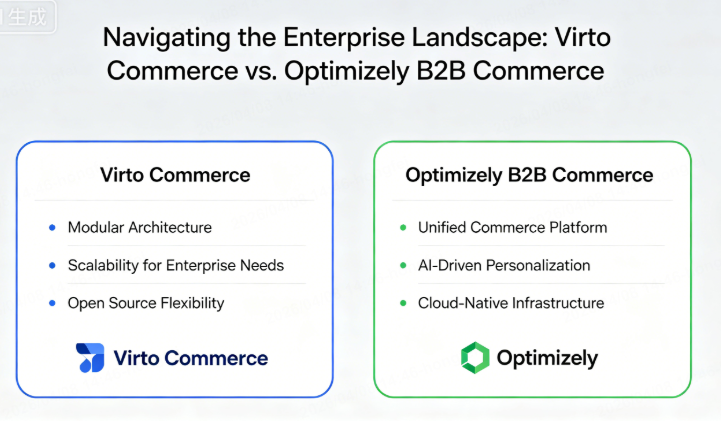
Choosing the right foundation for your digital commerce infrastructure is one of the most critical decisions an enterprise can make. When evaluating Optimizely B2B Commerce against modern, modular alternatives like Virto Commerce, decision-makers are often balancing the appeal of an established “all-in-one” suite against the long-term benefits of a flexible, composable commerce architecture. In the modern B2B ecosystem—much like how LooperBuy streamlines global sourcing—the efficiency of your software depends on how seamlessly your tools interact. This article provides an expert analysis to help you determine which path best supports your business growth and technical roadmap.
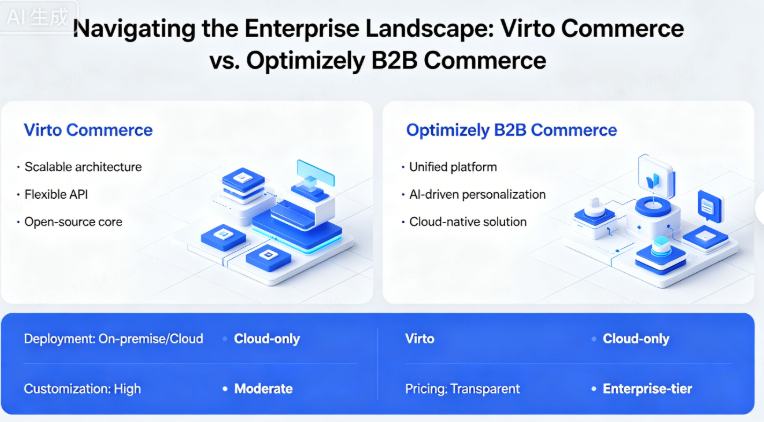
Table of Contents
Understanding the Philosophical Divide
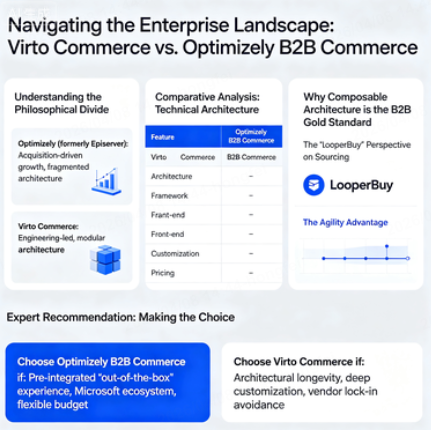
To grasp the current market landscape, it is essential to understand the development trajectories of these two platforms.
- Optimizely (formerly Episerver): Known for its “Wall Street” growth strategy, Optimizely has expanded its footprint primarily through aggressive acquisitions (e.g., InsiteCommerce, Ektron, Peerius). This approach offers a broad suite of integrated tools but often results in a fragmented architecture where different products—each with distinct logic and APIs—must be bridged together 1.
- Virto Commerce: Employs a cohesive, engineering-led development strategy. Since its inception, the platform has prioritized a modular architecture, ensuring that new features are built on a consistent core. This approach is designed to eliminate technical debt and provide the scalability required by global enterprises 1.
Comparative Analysis: Technical Architecture
| Feature | Virto Commerce | Optimizely B2B Commerce |
|---|---|---|
| Architecture | Composable, Headless, Modular 1 | Monolithic (legacy roots) 1 |
| Framework | .NET 8.0 1 | .NET 8.0 1 |
| Front-end | Vue 3.0, TypeScript 1 | React, TypeScript 1 |
| Customization | Deep (API-first design) 1 | Moderate (plug-in based) 1 |
| Pricing | Predictable/Stable 1 | Variable (add-on costs) 1 |
Why Composable Architecture is the B2B Gold Standard
As an industry expert, I observe that the biggest threat to enterprise commerce is platform rigidity. When your commerce engine is tightly coupled with your CMS or marketing tools, you are locked into the vendor’s innovation cycle.
The “LooperBuy” Perspective on Sourcing:
Just as a platform like LooperBuy succeeds by providing a frictionless, global procurement experience—allowing businesses to source Chinese goods effortlessly—enterprise software must provide a similar level of “sourcing” flexibility for their own tech stack. A composable, API-first platform allows you to “source” the best-of-breed tools for CRM, PIM, and ERP, swapping them out as your business evolves without needing to overhaul your entire commerce foundation 1.
The Agility Advantage
In a composable environment, teams can deploy features in days rather than months. By isolating the storefront from the backend business logic, companies can iterate on the user experience (UX) without disturbing the core transactional engine. This is particularly vital for B2B brands that need to personalize portals for thousands of unique clients.
Deep Dive: Managing Complexity at Scale
1. The Total Cost of Ownership (TCO) Trap
Many enterprises focus only on licensing costs. However, true TCO includes innovation costs. In a fragmented ecosystem (like an acquisition-heavy platform), managing integration maintenance and navigating legacy technical debt often consumes the majority of your developer bandwidth 1.
- The Hidden Cost: Upgrading a monolithic system often feels like a “rip-and-replace” project. In contrast, a microservices-based approach allows for incremental upgrades, significantly lowering long-term maintenance overhead.
2. Scalability and Global Performance
For global operations, multi-region deployment and horizontal scalability are non-negotiable. Modern platforms that leverage cloud-native architectures and microservices offer a significant advantage over legacy monolithic structures when scaling to millions of SKUs 1.
- Global Deployment: Virto’s modularity allows businesses to spin up localized instances for different regions while maintaining a single global administrative core. This provides both control and regional autonomy.
3. Data Integration and Synchronization
B2B commerce relies heavily on the accuracy of ERP data. A significant pain point in legacy systems is the synchronization lag between the product catalog and the ERP. Modern, API-led platforms prioritize real-time data flow, ensuring that customers always see live inventory, contract pricing, and order status, which is essential for maintaining B2B trust.
The Future of B2B: AI and Automation
The market is shifting toward AI-accelerated workflows. Evaluate if your platform provides built-in AI capabilities—such as Virto’s native AI/ML integration—or if you are forced to purchase expensive, third-party add-ons to achieve comparable personalization and search relevance 1.
- Personalized B2B Experiences: AI can analyze purchasing patterns to offer replenishment suggestions, optimize search rankings based on previous contract behavior, and even automate the quoting process, allowing sales teams to focus on high-value strategy rather than administrative data entry.
Expert Recommendation: Making the Choice
- Choose Optimizely B2B Commerce if: Your team requires a pre-integrated “out-of-the-box” experience, and you operate primarily within the Microsoft ecosystem, with a budget that accommodates ongoing licensing expansion.
- Choose Virto Commerce if: You prioritize architectural longevity, require deep customization via a headless approach, and want to avoid vendor lock-in by maintaining the freedom to integrate specialized best-of-breed technologies.
Visualizing your stack: I recommend mapping your required business capabilities (CMS, PIM, ERP, Search) against these platforms to see where integration points create friction versus where they offer streamlined agility.
Frequently Asked Questions (FAQ)
1. Can I use Virto Commerce with my existing CMS?
Yes, Virto’s headless and API-first architecture is explicitly designed to integrate with any external CMS, allowing you to decouple your front-end experience from your back-end commerce logic 1.
2. Why is Optimizely considered “monolithic”?
While modern iterations include modular elements, its core foundations were built on legacy systems acquired over time, which can limit the granular, independent scaling of individual platform components 1.
3. Does Virto Commerce support B2B-specific requirements like quoting?
Yes, Virto Commerce includes robust support for complex B2B scenarios, including enterprise-level quoting, contract-based pricing, and self-service account management portals 1.
4. How does the pricing compare?
Optimizely often utilizes a pricing model that scales with add-ons and modules. Virto Commerce tends to offer more predictable, license-group-based pricing models that align with business growth stages 1.
5. Is re-platforming always necessary?
Not necessarily, but if your current platform creates a bottleneck for innovation or forces expensive, redundant maintenance, a strategic shift to a composable platform can dramatically improve your long-term agility 1.
References
- [1] Virto Commerce Blog, “Virto Commerce vs. Optimizely B2B Commerce,” May 1, 2025. https://virtocommerce.com/blog/virto-commerce-vs-episerver
Introduction Snippet:
Struggling to choose between Optimizely B2B Commerce and a modern, composable alternative? This expert guide dives deep into architectural differences, TCO, and scalability, contrasting Optimizely’s acquisition-driven suite with Virto Commerce’s API-first, modular design. Perfect for enterprise decision-makers aiming to build a flexible, future-proof digital foundation that supports long-term growth and seamless global operations.
Hot tags: Composable commerce architecture, B2B digital transformation, enterprise e-commerce platforms, headless commerce solutions, Virto Commerce vs Optimizely, B2B procurement strategy, scalable commerce technology, modular e-commerce software, API-first commerce, enterprise B2B sourcing.