B2B returns management and reverse logistics can determine whether an international seller protects profit or absorbs avoidable losses. This guide explains how global B2B businesses can build an RMA workflow, inspect returned inventory, reduce cross-border return costs, improve supplier accountability, and turn returns data into stronger sourcing and fulfillment decisions.
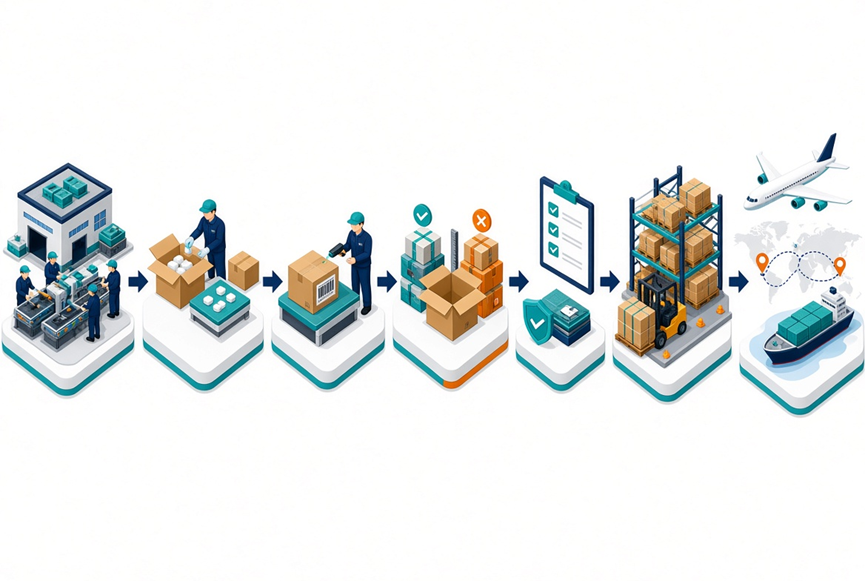
B2B returns management is no longer a back-office task. For wholesalers, marketplace sellers, distributors, and private-label brands, it is a direct driver of margin protection, buyer trust, inventory accuracy, and supply-chain resilience.
In my experience working with cross-border sourcing and fulfillment workflows, the strongest sellers do not treat a return as a simple refund event. They treat it as structured operational data: *What failed? Where did it fail? Can the product be recovered? Who should pay? How can the same issue be prevented on the next order?*
For businesses sourcing from China and selling internationally, these questions matter even more. A poorly managed return can create duplicate shipping costs, customs complications, unsellable inventory, delayed replacements, and damaged commercial relationships. A clear B2B reverse logistics strategy helps sellers resolve issues faster while reducing unnecessary stock, storage, and logistics costs.
Table of Contents
What Is B2B Reverse Logistics?
Reverse logistics is the controlled movement of goods from the buyer back to the seller, supplier, warehouse, repair center, recycler, or another approved destination. It includes every step required to handle an item after a buyer reports a problem, changes an order, rejects delivered goods, or returns excess inventory.
In B2B commerce, reverse logistics often includes more than receiving a parcel and issuing a refund. It may involve:
– Return request review and approval
– Product identification and serial or batch tracking
– Return Merchandise Authorization (RMA) creation
– International shipping and customs coordination
– Warehouse receiving and condition inspection
– Quality-control documentation
– Repair, replacement, credit, refund, resale, recycling, or disposal
– Supplier claims and root-cause analysis
– Inventory and accounting updates
A return process is especially important when the products involve bulk quantities, customized packaging, private labels, technical specifications, components, electronics, apparel, or products with compliance requirements.
We define reverse logistics as the process of goods flowing back from the customer to the enterprise for inspection, reprocessing, refurbishment, recycling, disposal, or return to stock (as available inventory).Its core insight remains highly relevant: returns are unavoidable, but the financial impact depends heavily on how systematically the business handles them.
Why B2B Returns Management Matters More Than Ever
A B2B buyer may place orders less frequently than a consumer, but each transaction can carry a much higher value. A single shipment containing incorrect sizes, damaged packaging, wrong product variants, missing accessories, or failed components can affect an entire resale program or production schedule.
The wider retail market illustrates the scale of the problem. The National Retail Federation estimated that retail returns would total $849.9 billion in 2025, with retailers expecting 15.8% of annual sales to be returned. These figures are largely retail-focused rather than B2B-specific, but they show why returns capacity has become a serious commercial capability rather than an afterthought.
For B2B sellers, a well-designed returns program can produce four practical benefits:
| Business area | Effect of poor returns handling | Value of a controlled process |
| Cash flow | Slow credits, duplicate refunds, uncertain liability | Faster and auditable settlement decisions |
| Inventory | Returned products become untracked or unusable | Clear disposition: restock, repair, resell, recycle, or dispose |
| Buyer retention | Delays and unclear communication weaken trust | Predictable updates and faster issue resolution |
| Supplier quality | Repeat defects remain hidden | Return codes reveal product, packaging, and fulfillment failures |
| Logistics cost | Expensive international return shipments | Local disposition and consolidated return decisions reduce waste |
The best return is the one that never happens. However, when a return is necessary, the goal is not always to physically move the goods back to China. In many cross-border situations, the more economical option may be a local replacement, partial credit, controlled disposal, local liquidation, or a return to a regional consolidation hub.
The Core B2B Returns Workflow
A reliable B2B returns management process should be consistent across customers, product lines, suppliers, and fulfillment partners. The following workflow can serve as a practical baseline.
1. Define Return Eligibility Before the Order Ships
Returns become expensive when the original terms are vague. Before an order is confirmed, the seller should make key conditions visible in the quotation, purchase order, product page, invoice, and service agreement.
Define:
– Return window and reporting deadline
– Product categories that are eligible or excluded
– Requirements for customized, branded, or made-to-order goods
– Accepted proof, such as photos, videos, carton labels, or inspection reports
– Who pays for return transportation in different scenarios
– Whether the available remedy is a refund, replacement, repair, discount, or account credit
– Requirements for keeping original packaging, accessories, and product labels
– Rules for damaged, used, opened, or incomplete goods
For example, a buyer receiving a standard stocked item may be eligible for a return within a defined period. A buyer receiving an OEM product with custom logo printing may instead be eligible for defect-related replacement or credit, rather than a discretionary return.
2. Create a Clear Return Merchandise Authorization
An RMA, or Return Merchandise Authorization, is a controlled record that links the buyer, original order, returned item, issue type, evidence, settlement request, and final outcome.
The RMA process provides buyers with a standardized way to request refunds, repairs, or replacements, while enabling sellers to manage such matters through a unified reporting system.
A strong B2B RMA form should capture:
– RMA number
– Buyer company and contact person
– Original purchase order and invoice number
– Product SKU, model, variation, and quantity
– Batch, lot, serial number, or carton number where applicable
– Return reason code
– Photos and videos of the issue
– Requested resolution
– Shipping destination and return method
– Inspection result
– Final settlement decision
– Root-cause category and corrective action
Avoid a free-text-only return form. Standardized return reason codes make it possible to identify patterns over time.
Useful codes include:
– Wrong item shipped
– Wrong quantity shipped
– Transit damage
– Packaging damage
– Missing component
– Product defect
– Product does not match approved specification
– Compliance or documentation issue
– Buyer ordering error
– Unsold stock or commercial return
3. Decide Whether a Physical Return Is Financially Sensible
One of the biggest gaps in many returns discussions is the assumption that every return should travel back to the original warehouse. In cross-border B2B commerce, that is often the most expensive option.
Before authorizing physical return shipping, calculate the net recovery value:
Net Recovery Value=Recoverable Product Value−Return Freight−Handling Cost−Customs Cost−Refurbishment Cost
If the result is negative, a physical return may not be justified.
Instead, consider alternatives:
– Send replacement stock without requiring a return for low-value defects
– Offer a partial credit for cosmetically damaged but usable goods
– Arrange local disposal with photo evidence
– Return products to a regional warehouse rather than China
– Liquidate suitable stock through a local approved channel
– Consolidate multiple returns before arranging international transport
– Repair or repackage products at a local partner facility
This decision should be based on product value, condition, resale potential, destination country, import rules, and buyer relationship—not simply on the original unit price.
Quality Inspection Turns Returns Into Prevention
The most valuable part of reverse logistics is not the return shipment. It is the learning that follows inspection.
Each incoming return should be reviewed through a defined inspection process:
1. Match the item against the RMA, SKU, batch, and original order.
2. Photograph the outer carton, labels, internal packaging, and product condition.
3. Test functional performance when relevant.
4. Classify the product condition.
5. Determine whether it can be restocked, repaired, repackaged, resold, recycled, or disposed of.
6. Identify responsibility: supplier, warehouse, carrier, buyer, or unclear.
7. Record corrective action and update the supplier or fulfillment scorecard.
A practical condition-grading framework can simplify decisions:
| Grade | Typical condition | Recommended action |
| A | Unopened, complete, resale-ready | Return to available inventory |
| B | Opened but functional, minor packaging issues | Repack, relabel, or sell through an approved channel |
| C | Repairable or incomplete | Repair, harvest usable parts, or sell as refurbished where appropriate |
| D | Unsafe, defective, or non-compliant | Recycle or dispose through approved procedures |
For a global seller sourcing from China, this process should connect directly to supplier performance. If five returns involve the same broken zipper, missing charger, incorrect carton marking, or wrong color variation, the business should not solve five isolated cases. It should open one supplier corrective-action review.
Reduce Returns Before They Enter the System
A modern B2B returns strategy begins upstream. Many returns are preventable when product information, inspection requirements, and buyer expectations are clear before checkout.
Improve Product and Order Accuracy
Use detailed product data that answers operational questions, not just marketing questions:
– Dimensions, material, finish, weight, and compatibility
– Product photos from multiple angles
– Packaging type, carton quantity, carton dimensions, and gross weight
– Available colors, sizes, variants, and tolerances
– Minimum order quantity and customization requirements
– Production lead time and shipping timeline
– Compliance documents and test reports when applicable
– Clear sample-approval and pre-production confirmation process
For complex B2B orders, a buyer should confirm a final specification sheet before production starts. This protects both sides from vague expectations such as “premium quality,” “same as image,” or “standard export packaging.”
Use Pre-Shipment Inspection Strategically
A pre-shipment inspection is especially valuable for first orders, new suppliers, custom products, high-value goods, and high-risk categories.
An effective inspection checklist should verify:
– Quantity and SKU accuracy
– Product appearance and workmanship
– Functional performance
– Color, size, and labeling accuracy
– Packaging and carton marks
– Barcode or serial-number requirements
– Product accessories and manuals
– Destination-market compliance requirements
LooperBuy positions its service around China sourcing, quality inspection, free warehousing, and global fulfillment. For sellers seeking lower inventory exposure, combining supplier coordination, inspection, consolidation, and fulfillment through one operating workflow can reduce handoffs that frequently create shipment errors and return disputes.
Build a Data Dashboard That Shows What Is Really Failing
Return rate alone is not enough. A low return rate can still hide serious losses if a few large B2B claims are costly. Track both frequency and financial impact.
Monitor these metrics monthly:
– Return rate by order, SKU, supplier, category, and destination
– Return value as a percentage of sales
– Return reason by frequency and financial impact
– Defect rate by production batch
– Wrong-item and wrong-quantity rate
– Damage rate by carrier, shipping route, and packaging type
– Average RMA resolution time
– Cost per return case
– Recovery rate from restocking, repair, resale, or recycling
– Replacement shipment rate
– Supplier-attributable claim value
– Buyer dispute rate
A useful management rule is simple: prioritize the return reasons with the highest total cost, not only the highest case count.
For example, 40 low-value packaging complaints may require process improvement, but three defective bulk equipment shipments may represent far greater financial risk. Your dashboard should make that distinction visible.
GS1’s EPCIS standard is designed to support supply-chain visibility by capturing and sharing event information about what happened to a product, where and when it happened, why it happened, and how it moved through the supply chain. For businesses with serialized, regulated, or high-value products, this type of traceability can make return validation and responsibility assignment far more reliable.
A Practical 90-Day Improvement Plan
You do not need to rebuild every process at once. Start with the products and customers that create the greatest financial exposure.
Days 1–30: Map and Diagnose
– Review the top 20 SKUs by sales value and return value
– Collect existing customer complaints, refund records, and replacement orders
– Create standard return reason codes
– Document current approval, inspection, settlement, and inventory processes
– Identify whether each return can be traced to product, supplier, warehouse, carrier, or buyer error
– Publish a clear B2B returns policy
Days 31–60: Standardize and Control
– Launch an RMA form with required order and product fields
– Build approval rules for refund, replacement, repair, and physical return
– Create inspection checklists and product condition grades
– Add photo evidence requirements for transit damage and defects
– Train support, warehouse, and sourcing teams on the same workflow
– Establish supplier claim procedures and response deadlines
Days 61–90: Improve and Scale
– Review the highest-cost return reasons
– Update supplier specifications and inspection standards
– Improve product listings, packaging instructions, and buyer confirmation steps
– Introduce a local or regional returns solution for key markets
– Build monthly supplier and logistics performance scorecards
– Use findings to reduce repeat errors in future sourcing orders
Choose a Returns Partner That Supports Your Entire Workflow
A returns provider should not only accept parcels. For B2B sellers, the partner must support the operational decisions that happen after a product arrives.
When evaluating a sourcing, fulfillment, or logistics partner, ask:
– Can the partner inspect returned goods against a documented standard?
– Can it provide photos, videos, and inspection reports?
– Can it separate restockable stock from defective stock?
– Can it consolidate inventory and shipments?
– Can it coordinate supplier claims in China?
– Can it support dropshipping, wholesale replenishment, and custom orders?
– Can it provide order visibility and proactive status updates?
– Can it help prevent repeat issues through quality-control feedback?
For global sellers, the strongest model is an integrated one: sourcing, inspection, storage, fulfillment, returns documentation, and supplier communication should operate as connected parts of one system.
Turn Returns Into a Better Buyer Experience
A commercial return is often a difficult moment, but it can still strengthen the relationship if the response is fast, transparent, and evidence-based.
Buyers want three things:
– A clear explanation of what happens next
– A reasonable resolution timeline
– Confidence that the same issue will not happen again
Do not force buyers to chase updates. Send status messages when the RMA is received, approved, shipped, inspected, settled, and closed. Explain whether the resolution is a refund, account credit, replacement, repair, or another agreed outcome.
A reliable returns process protects more than inventory. It protects your reputation.
If you source products from China for global resale, LooperBuy can help simplify the broader workflow—from product sourcing and supplier coordination to quality inspection, warehousing, order fulfillment, and shipping. Build a more controlled operation so that fewer issues become costly returns in the first place.
Frequently Asked Questions
1. What is B2B returns management?
B2B returns management is the process of approving, receiving, inspecting, resolving, and recording product returns between businesses. It includes refund or credit decisions, replacement handling, inventory updates, quality control, and supplier or carrier claims.
2. What is reverse logistics in B2B eCommerce?
Reverse logistics is the movement of goods from a buyer back to the seller, warehouse, repair center, recycler, supplier, or other approved location. It also includes the operational decisions made after the product is received.
3. What is an RMA number?
An RMA number is a unique Return Merchandise Authorization identifier assigned to a return case. It connects the returned product to the original order, buyer, reason for return, evidence, inspection result, and settlement decision.
4. Should international buyers always send returned products back to China?
No. Physical return shipping is not always economical. Sellers should compare the item’s recoverable value with return freight, customs, handling, repair, and administrative costs. Local disposal, partial credit, replacement, or regional consolidation may be more practical.
5. How can B2B sellers reduce product returns?
Sellers can reduce returns by improving product specifications, using accurate images, confirming buyer requirements, approving samples, conducting pre-shipment inspections, improving packaging, and analyzing return reason data by supplier, SKU, batch, and shipping route.
6. Who should pay for B2B return shipping?
Responsibility should be defined in the purchase terms. If the seller, supplier, warehouse, or carrier caused the error, they may be responsible. If the buyer ordered the wrong product or changed requirements after production, the buyer may bear the cost. Written terms and evidence are essential.
7. What should happen to returned inventory?
Returned inventory should be inspected and categorized. Depending on its condition, it may be restocked, repackaged, repaired, sold as refurbished, liquidated, recycled, or disposed of according to applicable safety and environmental requirements.
References
2. [Consumers Expected to Return Nearly $850 Billion in Merchandise in 2025]
3. [GS1 — EPCIS and CBV Supply Chain Visibility Standards]
4. [U.S. Environmental Protection Agency — Sustainable Materials Management]
5. [LooperBuy — B2B China Sourcing Platform and Dropshipping Solutions]