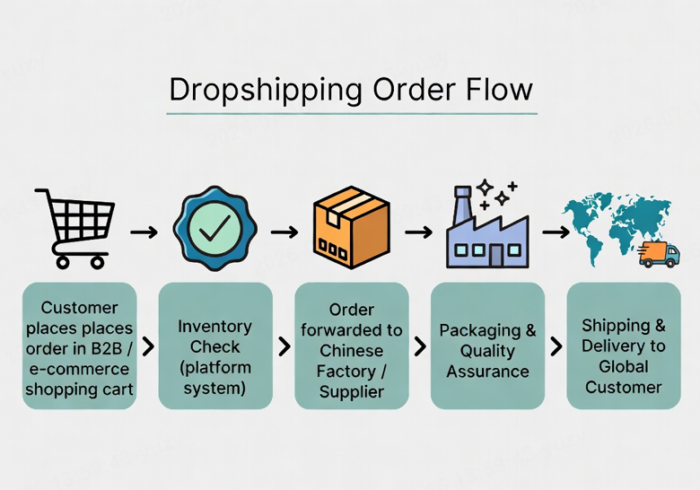
Global B2B buyers rely on online wholesale marketplaces for scale, but risk, logistics, and inventory costs remain high. This expert guide explains how to combine platforms like Alibaba and Global Sources with Looperbuy’s China sourcing and dropshipping to build a leaner, more resilient B2B operation.
In the past decade, I’ve helped brands transition from risky ad‑hoc China sourcing to reliable, systemized B2B procurement—and the difference in margin, lead time, and peace of mind is dramatic. Today’s top B2B wholesale marketplaces can unlock global growth, but only if you understand their real strengths, blind spots, and how a specialist platform like Looperbuy fits into your long‑term sourcing strategy.
Table of Contents
Why Modern B2B Buyers Rely on Wholesale Marketplaces
Global wholesale marketplaces have become the default starting point for sourcing, especially for cross‑border trade between Asia, Europe, and North America. They aggregate millions of products, thousands of suppliers, and built‑in tools for catalog management, payments, and logistics. From a practitioner’s point of view, three critical advantages stand out:
– Faster supplier discovery for new categories, niches, or seasonal lines. [wizcommerce]
– Higher bulk order potential thanks to large buyer bases and international reach. [globalsources]
– Embedded tools for order, shipping, and inventory management that reduce internal admin work. [virtocommerce]
At the same time, marketplace sourcing introduces new challenges: price commoditization, inconsistent product quality, and the need for persistent supplier vetting beyond platform-level ratings. This is where a focused procurement and dropshipping partner like Looperbuy can change the risk profile of your entire operation. [clickpost]
The 11 Leading B2B Wholesale Marketplaces—and What They’re Really Good At
Global Sources’ guide to “11 Best Wholesale Marketplaces in 2025” offers a useful benchmark, but it focuses primarily on platform pros and cons without fully translating them into buyer strategy. As someone who has sat on both sides of the table—brand, distributor, and sourcing consultant—I look at each marketplace in terms of how a professional buyer should actually use it. [globalsources]
Snapshot of the Top Marketplaces (and Strategic Use Cases)
| Marketplace | Strategic strength | Typical use case | Key watch‑out |
| Global Sources | Asian supplier network & trade fairs | Electronics, hardware, trade show sourcing | MOQ and quality verification |
| Alibaba | Global scale, huge catalog | Bulk manufacturing in Asia | Vetting and post‑quote price changes |
| Wholesale2B | Dropshipping connectors | Store owners testing SKUs | Inventory visibility limits |
| Grainger | Industrial products & MRO | Factories, facilities procurement | Higher fees, industrial focus |
| DHgate | China dropshipping & bulk | SME cross‑border sourcing | Product quality inconsistency |
| eBay | Global auction and marketplace | Opportunistic buys, surplus | Mixed quality, fee complexity |
| SaleHoo | Vetted supplier directory | New dropshippers & wholesalers | Membership cost, competition |
| Made‑in‑China | Exporter focus & customization | OEM/ODM from China | Language and QC challenges |
| Mable | Grocery and food niche | Foodservice & convenience stores | Category limitation |
| TradeWheel | US‑focused B2B sourcing | New US buyers entering B2B | Fee levels and competition |
| OrderChamp | European retail network | Boutique retailers sourcing brands | Competition and range limits |
From a practical standpoint, no single marketplace can cover every sourcing need, especially if you are running a multi‑category, multi‑channel B2B business. The most resilient companies I work with combine:
– A couple of global marketplaces (e.g. Alibaba + Global Sources) for broad discovery. [coderlegion]
– One or two regional or niche platforms (e.g. Mable, OrderChamp) for category depth. [retailgear]
– A specialized partner like Looperbuy to standardize sourcing operations from China, handle dropshipping, and reduce inventory risk.
The Hidden Gaps in Typical Marketplace Guides
Most “top marketplace” articles stop at listing features, fees, and basic pros and cons. From a 2026 buyer’s perspective, three major information gaps matter:
1. No clear guidance on operational risk.
Guides rarely explain how to mitigate issues like counterfeit products, quality drift over repeated orders, or supplier churn. [clickpost]
2. Limited coverage of logistics reality.
Cross‑border shipping times, customs handling, and last‑mile delivery can eat margin and damage customer experience, but are often only mentioned as “potential delays.”
3. Little discussion of hybrid models.
Very few guides show how to blend marketplaces, dedicated procurement platforms, and dropshipping to minimize capital lock‑in and warehouse costs. [coderlegion]
In my work with B2B brands, these gaps directly translate into lost profit and operational firefighting—stockouts, returns, and unsellable inventory sitting in third‑party warehouses. A platform like Looperbuy exists precisely to plug these holes with specialized China sourcing and end‑to‑end dropship fulfillment.
How Looperbuy Supports Global B2B Sellers
Looperbuy is designed for global B2B sellers who want China‑sourced products without the traditional burdens of stock, warehousing, and complex logistics management. Drawing on the marketplace landscape above, three differentiators become clear:
– Reliable China sourcing with category breadth.
Looperbuy focuses on curated Chinese suppliers, combining the scale benefits seen on platforms like Alibaba and DHgate with added emphasis on reliability and product consistency.
– Integrated dropshipping and fulfillment.
Instead of forcing you to purchase and store bulk inventory, Looperbuy supports direct fulfillment from supplier to your end customer or downstream partners, reducing warehousing and stock‑out risk. [virtocommerce]
– Cost reduction across the procurement chain.
By minimizing inventory holding, warehouse management, payment reconciliation complexity, and logistics coordination, Looperbuy helps B2B sellers preserve working capital and simplify cash flow planning. [coderlegion]
For B2B owners, the result is not just “cheaper sourcing” but a structurally lighter business model that scales faster because capital is not trapped in unsold stock.
Practical Framework for Choosing the Right Platform Mix
While Global Sources’ guide highlights reputation, fees, user base, and niche focus, seasoned buyers need a more practical, step‑by‑step selection framework. Here is a simple, field‑tested approach you can apply: [virtocommerce]
Step 1 – Define Your Sourcing Objectives
Ask three core questions before opening any platform:
1. What product categories and specifications do you need in the next 12–24 months?
2. How much capital can you afford to lock in inventory versus operate asset‑light?
3. What level of control do you require over branding, packaging, and customization?
Answers here determine whether you lean towards mass marketplaces (for maximum variety) or specialized partners like Looperbuy (for predictable China sourcing and dropshipping).
Step 2 – Narrow Down Platforms by Role
Rather than chasing “the best marketplace,” assign each platform a clear role:
– Use Global Sources or Alibaba for supplier discovery and RFQ on new product lines. [globalsources]
– Use niche platforms (Mable, OrderChamp) for category‑specific replenishment and regional buyers. [retailgear]
– Use Looperbuy as your China sourcing and dropshipping backbone, especially when you want to avoid warehousing in your target markets.
This role‑based thinking prevents overlapping tools and makes it easier to standardize internal processes and reporting.
Step 3 – Evaluate Risk and Support
Beyond fees and catalog size, prioritize:
– Supplier verification and track record over simple ratings. [tonysourcing]
– Quality control mechanisms (sampling, inspections, ongoing audits).
– Logistics and returns handling for cross‑border shipments. [clickpost]
From my experience, platforms that offer human support and transparent escalation routes reduce long‑term risk far more than a marginal discount on unit price.
Actionable Steps to Start Sourcing Smarter with Looperbuy
Once you understand the marketplace landscape and Looperbuy’s role, you can move from theory to execution. Here is a practical roadmap.
Step 1 – Map Your Product Portfolio
– List current and planned products for the next year.
– Tag them as “test”, “core”, or “experimental,” and mark which ones are suitable for dropshipping versus bulk stock.
Step 2 – Assign Platforms Per Product
– Route test and experimental SKUs through Looperbuy’s China sourcing and dropshipping to avoid over‑stocking.
– Use major marketplaces for initial supplier scouting when you need custom manufacturing or very specialized industrial components.
– Keep niche marketplaces for regional, category‑specific needs like grocery or boutique retail.
Step 3 – Standardize Processes
– Define one internal purchasing workflow that includes RFQ, sample review, approval, and order placement for all platforms.
– Integrate your ERP or inventory tools with Looperbuy and selected marketplaces where possible to maintain a single source of truth. [coderlegion]
As you iterate, track metrics like fulfillment time, return rate, and SKU profitability by platform. Over time, most teams naturally shift more volume to partners that combine sourcing reliability with logistics excellence—exactly where Looperbuy is positioned.
Real‑World Use Cases for Looperbuy in Global B2B
Based on typical patterns in global marketplace usage, three representative scenarios show how Looperbuy can be deployed alongside mainstream platforms:
1. Amazon FBA and B2B resellers:
Sellers source new SKUs on Alibaba or Global Sources, then migrate proven products to a Looperbuy‑enabled pipeline that ships directly to FBA or B2B buyers, trimming storage and handling overhead. [globalsources]
2. Regional distributors expanding catalog:
A European distributor discovers new Chinese brands via Made‑in‑China and DHgate but uses Looperbuy to consolidate ordering, quality checks, and dropship fulfillment into regional warehouses or directly to retail partners. [tonysourcing]
3. SME manufacturers adding complementary products:
A mid‑sized industrial company relies on Grainger for MRO supplies but uses Looperbuy to add China‑sourced complementary items (tools, accessories) without building a new warehouse network. [coderlegion]
In all three scenarios, Looperbuy reduces operational friction and capital risk, while marketplaces continue to serve as discovery engines and comparison benchmarks.
When Looperbuy Is the Smart Choice—and When It Isn’t
From an expert buyer’s angle, there are clear situations where Looperbuy provides outsized value:
– You want to scale product range from China without renting more warehouses or holding excess inventory.
– You operate in multiple B2B channels (online, wholesale, distribution) and need consistent cross‑border fulfillment.
– You prefer to shift internal focus from logistics firefighting to product development and customer relationships.
However, Looperbuy may be less suitable when:
– You require ultra‑specialized industrial components with heavy customization and long‑term OEM contracts.
– You already run deep, direct relationships with a small number of factories and prefer owning every step of the supply chain.
– Your primary need is enterprise procurement orchestration (e.g. SAP Ariba, Coupa) rather than sourcing and fulfillment. [virtocommerce]
The most mature buyers do not try to force one platform into every role; they orchestrate a portfolio where Looperbuy is a key instrument for China‑sourced, dropship‑ready products.
Start Testing Looperbuy in Your Sourcing Mix
If you are already using marketplaces like Global Sources, Alibaba, or DHgate, you don’t need to overhaul your entire sourcing strategy overnight. Instead, treat Looperbuy as a controlled experiment:
– Select 5–10 SKUs with stable demand but high inventory cost.
– Route new orders for these SKUs through Looperbuy’s China sourcing and dropshipping setup.
– Track the impact on stock levels, cash flow, lead times, and customer satisfaction over 1–2 quarters.
From a practical standpoint, this kind of measured trial gives you real data to decide how far to shift from inventory‑heavy models to a leaner, Looperbuy‑enabled B2B operation.
“Ready to cut inventory risk and simplify your China sourcing? Explore how Looperbuy can plug into your existing marketplace workflow and start with a low‑risk pilot on selected SKUs.”
FAQs
Q1: How is Looperbuy different from large marketplaces like Alibaba?
Looperbuy focuses on reliable China sourcing and integrated dropshipping, while Alibaba is primarily a massive marketplace for supplier discovery and bulk orders; in practice, many buyers use Alibaba to identify suppliers and Looperbuy to run ongoing, risk‑controlled fulfillment. [coderlegion]
Q2: Can Looperbuy help reduce warehousing and inventory costs?
Yes, by enabling direct fulfillment from Chinese suppliers to your customers or regional partners, Looperbuy helps you avoid over‑stocking and long‑term storage, which can significantly reduce warehousing and tied‑up capital. [virtocommerce]
Q3: Is Looperbuy suitable for small B2B businesses or only larger enterprises?
Looperbuy can support both: smaller B2B sellers gain access to structured China sourcing without building their own logistics network, while larger enterprises can use it to lighten certain product lines and expand catalog coverage. [virtocommerce]
Q4: How does Looperbuy fit with my existing procurement and ERP tools?
Looperbuy is typically positioned as a sourcing and fulfillment partner that can complement ERP‑backed procurement platforms; you keep your existing tools for approvals and budgeting while using Looperbuy to execute cross‑border sourcing and delivery. [coderlegion]
Q5: What categories work best with a Looperbuy‑enabled dropshipping model?
Most fast‑moving consumer and light industrial products sourced from China—electronics accessories, home goods, tools, and similar categories—tend to work well, especially where demand is steady but volatile enough to make heavy inventory risky. [tonysourcing]
References
1. Global Sources. “11 Best B2B Wholesale Marketplaces in 2025.” [globalsources]
2. WizCommerce. “11 Top B2B Wholesale Marketplaces to Know in 2026.” [wizcommerce]
3. CoderLegion. “Best B2B Procurement Platforms to Consider in 2026.” [coderlegion]
4. Virto Commerce. “B2B Purchasing and Sourcing: Platforms Overview & Explanation.” [virtocommerce]
5. TonySourcing. “China’s Top 11 Online Wholesale Markets: Complete B2B Guide.” [tonysourcing]
6. Shopify. “10 B2B Marketplaces for Finding Buyers in 2026.” [shopify]
7. ClickPost. “B2B Marketplaces: Top 10 Platforms to Find Buyers in 2026.” [clickpost]
8. Retailgear. “The Best B2B Wholesale Marketplaces Online for Retail Stores.” [retailgear]