As a B2B sourcing and logistics strategist with over 15 years of experience helping global brand owners, wholesalers, and manufacturers optimize their supply chains, I’ve seen one question come up repeatedly among businesses scaling their import operations: What is the BCO meaning in shipping, and why does it matter for my bottom line?
If you’re sourcing products from China or any global manufacturing hub, understanding the BCO meaning in shipping could be the difference between paying spot market rates or securing stable, long-term freight pricing.
In this guide, I’ll break down the BCO meaning in shipping, how it differs from working with freight forwarders and NVOCCs, the real cost and control advantages of being a Beneficial Cargo Owner, and practical steps to decide if the BCO model fits your 2026 sourcing strategy—all while keeping your supply chain resilient and profitable.
Table of Contents
What Is the BCO Meaning in Shipping? A Clear Definition
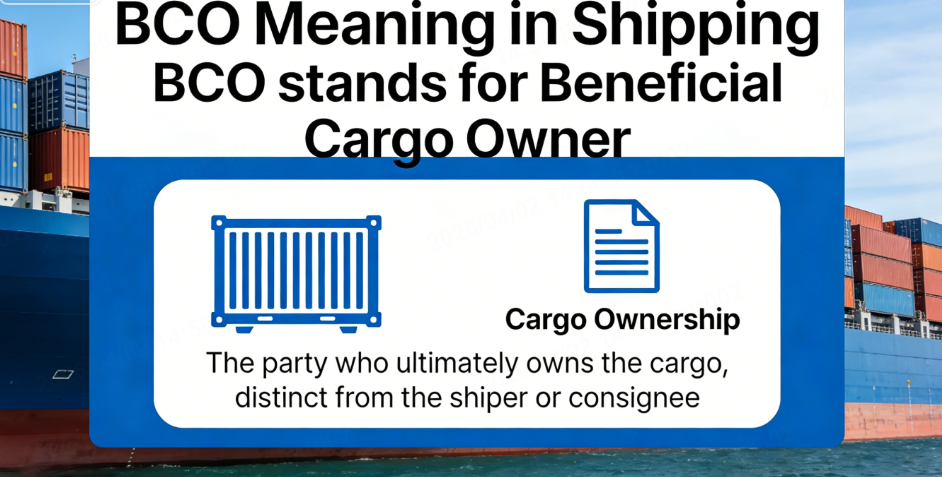
Let’s start with the basics. BCO stands for Beneficial Cargo Owner. In simple terms, a BCO is the legal owner of the goods being shipped—the company that ultimately owns the cargo, assumes the risks and benefits of transportation, and appears on the Bill of Lading as the importer or exporter of record .
Unlike intermediaries, BCOs contract directly with ocean carriers, airlines, or trucking companies rather than working through third parties like freight forwarders or NVOCCs.
In practice, BCOs are typically:
- Manufacturers shipping their own finished goods
- Retailers and wholesalers importing products for their stores or distribution networks
- Brand owners managing their own supply chain
Key takeaway: If your company owns the cargo and negotiates directly with carriers, you are operating as a BCO. If you hand off all logistics to a forwarder, you are not.
BCO vs. Freight Forwarder vs. NVOCC: What’s the Difference?
To fully grasp the BCO meaning in shipping, it helps to compare BCOs with other key players in international logistics. The table below clarifies the distinctions :
| Entity | Role | Ownership of Cargo | Contracts With | Best For |
|---|---|---|---|---|
| BCO (Beneficial Cargo Owner) | Owns the cargo | Full ownership | Directly with carriers | Large, stable import volumes |
| NVOCC (Non-Vessel Operating Common Carrier) | Consolidates cargo, issues its own Bill of Lading | Acts as shipper but does not own vessels | Carriers + shippers | Shippers wanting carrier-like service without direct contracts |
| Freight Forwarder | Arranges transport and documentation | None | Carriers, NVOCCs, truckers | Small to mid-sized shippers, complex door-to-door moves |
In short:
- BCOs own the goods and control the shipping contract.
- NVOCCs act like carriers but don’t own ships; they buy space from carriers and resell it.
- Freight Forwarders are logistics orchestrators—they don’t take ownership but manage the entire move.
A 2026 analysis from Jansson LLC notes that many successful importers actually blend both models: locking in core lanes under BCO contracts while using NVOCCs for overflow, seasonal surges, or new trade lanes .
Why the BCO Model Matters More in 2026
The global shipping market has become increasingly volatile. Between Red Sea disruptions, port congestion, and fluctuating container rates, BCOs who control their own carrier relationships have a distinct advantage.
According to industry data, approximately 63% of all vessel imports (by TEUs) were moved by BCOs in recent years—though this share has fluctuated due to market disruptions . The trend in 2025–2026 shows that BCOs with strong carrier relationships and minimum quantity commitments (MQCs) have fared better than those relying solely on spot markets.
Why now?
- Carriers prioritize contract customers during capacity crunches
- BCOs with MQCs secure predictable space and rates
- Direct relationships enable faster problem-solving during disruption
Core Advantages of Operating as a BCO
If you’re considering moving toward a BCO model, here are the tangible benefits you can expect :
1. Lower Freight Costs
By eliminating intermediary markups, BCOs typically save 10–25% on freight costs compared to going through forwarders or NVOCCs.
2. Rate Stability
Direct service contracts with carriers lock in rates for 6–12 months, protecting you from spot market spikes.
3. Priority Space Allocation
Carriers prioritize BCOs with MQCs when capacity gets tight—meaning your containers are less likely to get rolled.
4. Better Visibility and Control
Direct EDI/API connections with carriers give you real-time tracking, earlier allocation visibility, and cleaner data for decision-making.
5. Customized Service Levels
Choose carriers based on performance, transit times, and specific trade lane expertise—not just who your forwarder uses.
The Challenges: When BCO May Not Be the Right Fit
Being a BCO isn’t for every business. Here are the main hurdles :
| Challenge | Description |
|---|---|
| Volume requirements | Carriers typically require minimum annual volume (e.g., 50–100 FEUs) to offer a direct contract |
| In-house expertise | You need logistics staff to manage carrier negotiations, documentation, and compliance |
| Forecasting discipline | Under-shipping your MQC can trigger penalties; over-shipping requires spot market backup |
| Administrative burden | You handle your own bookings, customs filings, and exception management |
For smaller importers or those with volatile demand, starting with an NVOCC often makes more sense—then transitioning core lanes to BCO contracts as volume stabilizes .
BCO Contract Negotiation: 5 Practical Tips for 2026
If you’re ready to negotiate your first BCO contract, here’s what experienced logistics professionals recommend :
1. Start with a Lane-Level Forecast
Project weekly FEUs by port pair. Build three scenarios: conservative, base, and stretch. Your MQC should sit between conservative and base.
2. Don’t Just Negotiate Price—Negotiate Service KPIs
Include:
- On-time vessel departure targets
- Roll-over limits (e.g., no more than 2% of bookings rolled)
- Equipment availability SLAs
- Free time assumptions (demurrage/detention)
- Exception-handling contacts and timelines
3. Build in Guardrails for Volatility
Insert language allowing volume swing tolerance (e.g., ±15% by quarter) with quarterly business reviews to true-up rather than trigger penalties.
4. Specify Data and Visibility Clauses
Define which EDI/API events must be shared: booking confirmation, gate-in, loaded on vessel, departure, arrival, available for pickup, out-gate.
5. Diversify by Design
Avoid single-carrier concentration on critical lanes. Two carriers with staggered sailings smooth risk without doubling your admin work.
How LooperBuy Supports Your BCO Strategy
At LooperBuy, we understand that successful global sourcing isn’t just about finding the right products—it’s about controlling your entire supply chain, including freight.
While we specialize in connecting B2B buyers with vetted Chinese suppliers across 50+ product categories, our one-stop platform also provides:
- Transparent cost calculators that show total landed cost—including ocean freight, customs duties, and final-mile delivery
- Real-time shipment tracking from factory to warehouse
- Documentation support for customs compliance
- Logistics optimization through our carrier network
Whether you choose to operate as a BCO or prefer a managed service, LooperBuy gives you the visibility and control to make informed decisions.
Ready to take control of your supply chain? [Sign up for LooperBuy today] and access vetted Chinese suppliers, integrated logistics, and transparent pricing—all in one platform.
Frequently Asked Questions (FAQ)
1. What does BCO stand for in shipping?
BCO stands for Beneficial Cargo Owner—the legal owner of the goods being shipped who assumes the risks and benefits of transportation.
2. What is the difference between a BCO and a freight forwarder?
A BCO owns the cargo and contracts directly with carriers. A freight forwarder arranges transportation on behalf of shippers but does not own the goods.
3. Can a small business be a BCO?
Yes, but carriers typically require minimum volume commitments (e.g., 50–100 FEUs annually). Small businesses often start with NVOCCs and transition to BCO contracts as volumes grow.
4. What is an MQC in BCO contracting?
MQC stands for Minimum Quantity Commitment—the annual volume (usually in FEUs or TEUs) a BCO promises to ship with a carrier in exchange for rate stability and space allocation.
5. Is the BCO model right for my business?
If you have stable, predictable import volumes of at least 50–100 containers per year and in-house logistics expertise, the BCO model can save you 10–25% on freight costs. If your volumes are volatile or small, starting with an NVOCC is often better.
6. How does LooperBuy help BCOs?
LooperBuy provides vetted Chinese suppliers, transparent landed cost calculations, real-time tracking, and documentation support—giving BCOs the data and control they need to manage their supply chains effectively.
Article Summary (297 characters)
What is BCO meaning in shipping? This expert guide explains Beneficial Cargo Owner definition, BCO vs NVOCC vs forwarder, cost advantages, contract negotiation tips, and how LooperBuy helps BCOs source from China with full visibility.
References
- FreightAmigo. (2026). What Is a Beneficial Cargo Owner (BCO) in Shipping? Retrieved from https://www.freightamigo.com/en/blog/logistics/beneficial-cargo-owner-bco-explained/
- FreightAmigo. (2026). 航运中的受益货主 (BCO) 是什么? Retrieved from https://www.freightamigo.com/sc/blog/logistics/beneficial-cargo-owner-bco-explained/
- Jansson LLC. (2025). BCO vs. NVOCC: Which Model Fits Your 2025 Import Plan? Retrieved from https://janssonllc.com/logbook/bco-vs-nvocc-how-beneficial-cargo-owners-should-choose-in-2025/
- SeaRates. (2021). Understanding BCO Meaning in Shipping Along with 3 Other Main Terms in International Shipping. Retrieved from https://www.searates.com/ar/blog/post/understanding-the-4-main-terms-in-international-shipping
- 飞啊网. (2024). FAK、FIX、NVO、BCO,四种海运约号的区别到底在哪? Retrieved from https://www.feeair.com/zixun/bk_3_6410.html
- Modaltrans. (2025). The Benefits of Being a Beneficial Cargo Owner. Retrieved from https://modaltrans.com/blog/the-benefits-of-being-a-beneficial-cargo-owner-1
- PFC皇家物流. (2023). 海运里的BCO合约仓位是什么意思. Retrieved from https://www.pfcexpress.com/zhishi/haiyun/haiyun-7662.html
- Shipit Logistics. (2026). American Shipping 2026: Key Terms, Rules, and Hidden Fees. Retrieved from https://www.shipit.com/post/american-shipping-2026-key-terms-rules-and-hidden-fees
- Journal of Commerce. (2026). A few market predictions and some advice for BCOs as contract season heats up. Retrieved from https://www.prod.int.joc.com/article/a-few-market-predictions-and-some-advice-for-bcos-as-contract-season-heats-up-6155929
- LooperBuy. (2026). Supplies Business: A B2B Expert’s Guide to Sourcing Chinese Goods Globally with LooperBuy. Retrieved from https://blog.looperbuy.com/supplies-business-a-b2b-experts-guide-to-sourcing-chinese-goods-globally-with-looperbuy.html
Hot Tags
BCO meaning in shipping, Beneficial Cargo Owner definition, BCO vs NVOCC vs freight forwarder, BCO shipping contract, BCO logistics advantages, minimum quantity commitment MQC, BCO carrier negotiation, BCO supply chain control, LooperBuy B2B sourcing, China import BCO strategy, BCO freight cost savings, BCO contract negotiation tips, shipping terms for importers, beneficial cargo owner guide 2026, BCO vs forwarder comparison