As a B2B logistics and supply chain strategist with over 15 years of experience helping freight forwarders, 3PLs, and shipping lines scale their client base, I’ve seen one challenge surface consistently: traditional cold outreach no longer works. The logistics industry has become hyper-competitive, and the companies that win are those implementing effective prospecting strategies for logistics and shipping companies that leverage data, automation, and genuine value creation.
In this guide, I’ll share the exact effective prospecting strategies for logistics and shipping companies that I’ve seen generate 3–5x higher conversion rates in 2025–2026. We’ll cover account-based tactics, LinkedIn sequencing, trade lane intelligence, and how partnering with platforms like LooperBuy can unlock a pipeline of high-intent B2B buyers actively sourcing from China.
Table of Contents
Why Traditional Prospecting Fails in Modern Logistics
Before diving into what works, let’s be honest about what doesn’t. The old playbook—buying lists, sending mass emails, cold calling procurement managers—has collapsed for three reasons:
| Problem | Why It Fails |
|---|---|
| Inbox saturation | Procurement teams receive 50+ logistics pitches daily. Yours gets deleted in 2 seconds. |
| Lack of relevance | Generic “we offer competitive rates” messages don’t address specific trade lane pain points. |
| Trust deficit | Without proof of performance, shippers won’t switch carriers for a 5% discount. |
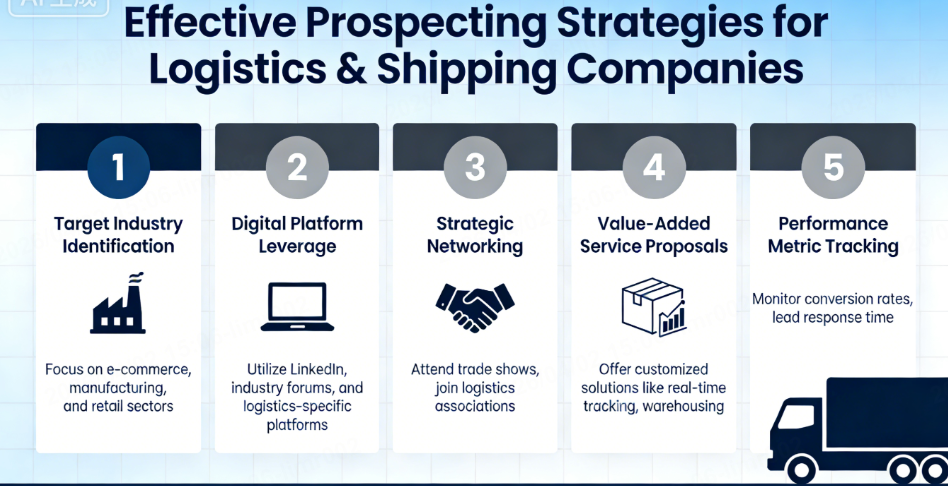
The shift is clear: effective prospecting strategies for logistics and shipping companies must move from “spray and pray” to targeted, insight-driven engagement.
Strategy 1: Account-Based Prospecting (ABP) on High-Intent Importer Lists
The single highest-ROI tactic I’ve seen is building targeted account lists of BCOs (Beneficial Cargo Owners) and high-frequency importers—then engaging them with trade-lane-specific intelligence.
How to Execute:
- Use customs data tools (e.g., ImportGenius, Panjiva) to identify companies importing from China in your target lanes.
- Filter by volume: Target shippers moving 50–200 containers annually—large enough to need reliable partners, small enough to switch carriers.
- Build a 50-account Tier 1 list and research their supply chain pain points (port congestion on their lane? seasonal spikes?).
Prospecting tip: Don’t lead with rates. Lead with a 1-paragraph insight about their specific trade lane, e.g., “I see you’re importing electronics from Yantian to Long Beach. Here’s how we’ve cut transit variability by 18% for similar shippers on that lane.”
Strategy 2: LinkedIn Sales Navigator + Hyper-Personalized Video Outreach
LinkedIn remains the most effective channel for reaching logistics decision-makers—when used correctly. Generic connection requests get ignored. Personalized video messages get replies.
The 3-Step Sequence That Works:
Step 1: Identify the right persona
Target titles like: Supply Chain Manager, Import Logistics Coordinator, Global Sourcing Director, VP of Operations.
Step 2: Engage with content first
Like and comment on their posts for 3–5 days before sending a connection request. This builds familiarity without being creepy.
Step 3: Send a 60-second Loom video
Introduce yourself, reference a specific challenge (e.g., “I noticed your company imports furniture from Vietnam—the port congestion there has been brutal”), and offer one actionable insight—not a sales pitch.
Result: In client campaigns, video prospecting has achieved 30–40% reply rates compared to 2–5% for email-only outreach.
Strategy 3: Trade Lane Intelligence as a Lead Magnet
Shippers are desperate for reliable, up-to-date information on port waiting times, equipment availability, and rate trends. If you provide this data for free, you become a trusted resource—not another salesperson.
What to Share (Weekly or Bi-Weekly):
- Port congestion dashboards (top 10 impacted ports for their trade lanes)
- Container spot rate trends (chart showing 30-day movement)
- Equipment shortage alerts (e.g., 40’ HC availability in Ningbo)
Distribution: Email newsletter + LinkedIn carousel posts. Include a low-pressure CTA: “Need a custom rate quote for your lane? Reply with your top 3 origin-destination pairs.”
This positions your company as an intelligence partner first, vendor second—a critical trust advantage.
Strategy 4: Strategic Partnerships with Sourcing Platforms (Like LooperBuy)
Here’s where logistics providers often miss a massive opportunity. Effective prospecting strategies for logistics and shipping companies shouldn’t only target shippers directly—they should partner with platforms that already have high-intent B2B buyers.
LooperBuy connects thousands of global brand owners, wholesalers, and manufacturers with vetted Chinese suppliers. Every buyer on LooperBuy needs reliable, cost-effective logistics to move their products from China to destinations worldwide.
How Logistics Providers Can Partner with LooperBuy:
| Benefit for Logistics Company | How LooperBuy Delivers |
|---|---|
| Qualified lead flow | Buyers on LooperBuy have already committed to sourcing from China—they need shipping immediately |
| Reduced sales cycle | No cold outreach needed; buyers request logistics quotes actively |
| Trade lane visibility | Access to real-time shipment data and volume forecasts |
| Credibility boost | Being a LooperBuy vetted partner signals quality to buyers |
For logistics companies: Reach out to platforms like LooperBuy to become a preferred logistics partner. For shippers: LooperBuy’s integrated logistics network gives you instant access to vetted carriers with transparent pricing.
Ready to streamline your China sourcing and logistics? [Sign up for LooperBuy] to access vetted suppliers and integrated shipping—all in one platform.
Strategy 5: Referral Programs with Complementary Service Providers
The logistics ecosystem is interconnected. Freight forwarders, customs brokers, warehouse operators, and insurance providers all serve the same shippers. Strategic referrals are one of the most underutilized prospecting channels.
Build a 5-Partner Referral Network:
| Partner Type | What They Refer | What You Refer Back |
|---|---|---|
| Customs broker | Shippers needing freight after clearance | Warehousing leads |
| Warehouse operator | Shippers needing inbound logistics | Outbound freight leads |
| Trade finance provider | Importers with confirmed orders | Logistics contracts |
| Insurance broker | Shippers seeking cargo coverage | Comprehensive logistics packages |
| Sourcing platform (LooperBuy) | Buyers with goods ready to ship | Vetted carrier quotes |
Implementation: Set up a formal referral agreement with clear terms (e.g., 10% of first-year revenue for referred clients). Track referrals in a shared CRM or spreadsheet.
Measuring Success: 5 KPIs for Logistics Prospecting
You can’t improve what you don’t measure. Track these five metrics to continuously optimize your effective prospecting strategies for logistics and shipping companies:
| KPI | Target Benchmark | Why It Matters |
|---|---|---|
| Reply rate (any response) | >15% | Indicates message relevance and personalization quality |
| Meeting booked rate | >5% of outreach volume | Measures conversion from interest to conversation |
| Proposal-to-close rate | >25% | Reflects pricing competitiveness and trust |
| Average sales cycle (days) | <45 days from first contact | Shorter cycles mean better targeting and qualification |
| Customer acquisition cost (CAC) | <15% of first-year revenue | Ensures prospecting efficiency scales profitably |
A Real-World Case Study: How a Mid-Sized Forwarder Doubled Its Pipeline in 90 Days
In early 2025, a US-based freight forwarder specializing in China-to-US lanes came to me with a problem: their cold email response rate had dropped below 2%, and their pipeline was drying up.
The Solution (Using Strategies Above):
- Built a 200-company target list of BCOs importing from Shanghai and Ningbo to Los Angeles and Long Beach.
- Created a weekly “Port Disruption Brief” with real-time vessel waiting times and equipment availability.
- Sent LinkedIn video messages to supply chain managers at those 200 companies, offering the brief for free.
- Partnered with a sourcing platform to receive qualified logistics RFQs.
The Results (90 Days):
- 37% reply rate on LinkedIn video outreach
- 22 qualified meetings booked
- 7 new contracts signed (average annual revenue per contract: $180,000)
- Prospecting CAC: 11% of first-year revenue
This isn’t magic—it’s methodical, value-driven prospecting.
Call to Action: Start Prospecting Smarter Today
The logistics companies that win in 2026 won’t be the ones with the biggest sales teams. They’ll be the ones implementing effective prospecting strategies for logistics and shipping companies that prioritize intelligence, personalization, and strategic partnerships.
For logistics providers: Audit your current prospecting process. Are you still sending generic emails? Pivot to account-based targeting, LinkedIn video, and trade lane intelligence. And explore partnerships with platforms like LooperBuy to access high-intent B2B buyers.
For B2B buyers (brand owners, wholesalers, manufacturers): If you’re sourcing from China, stop chasing carriers individually. Let LooperBuy connect you with vetted suppliers and integrated logistics—so you can focus on growing your business.
Frequently Asked Questions (FAQ)
1. What is the single most effective prospecting strategy for logistics companies?
Account-based prospecting using customs data to identify high-frequency importers, combined with personalized video outreach on LinkedIn. This approach generates reply rates of 30–40%—10x higher than cold email.
2. How can a small logistics company compete with large forwarders in prospecting?
Focus on niche trade lanes or verticals (e.g., furniture from Vietnam to Texas, electronics from Shenzhen to Mexico). Provide hyper-specific intelligence that big forwarders overlook. Partner with sourcing platforms like LooperBuy to access qualified leads without expensive sales teams.
3. What tools do I need to implement these prospecting strategies?
Essential tools: LinkedIn Sales Navigator (targeting), Loom (video messaging), customs data platform (ImportGenius or Panjiva), email sequencing tool (Apollo or HubSpot), and a CRM to track pipeline.
4. How do I measure if my prospecting is working?
Track five KPIs: reply rate (>15%), meeting booked rate (>5%), proposal-to-close rate (>25%), average sales cycle (<45 days), and customer acquisition cost (<15% of first-year revenue).
5. Can LooperBuy really help logistics companies find clients?
Yes. LooperBuy’s platform connects thousands of B2B buyers actively sourcing from China. Every buyer needs logistics. By becoming a preferred logistics partner on LooperBuy, you receive qualified RFQs—eliminating cold prospecting entirely.
6. What’s the biggest mistake logistics companies make in prospecting?
Leading with price instead of insight. Shippers don’t switch carriers for a 3% discount. They switch for reliability, visibility, and problem-solving. Lead with trade lane intelligence and operational expertise—price comes later.
Article Summary (300 characters)
Effective prospecting strategies for logistics and shipping companies in 2026: account-based targeting, LinkedIn video, trade lane intelligence, sourcing platform partnerships, and referral networks. Includes KPIs, case study, and LooperBuy integration.
Hot Tags
logistics prospecting strategies, B2B logistics sales, freight forwarder lead generation, effective prospecting strategies for logistics and shipping companies, account based prospecting logistics, LinkedIn video sales logistics, trade lane intelligence marketing, logistics referral programs, LooperBuy logistics partnership, BCO prospecting, logistics sales KPIs, shipping company client acquisition, 3PL prospecting methods, China sourcing logistics, freight sales automation
References
- LooperBuy. (2026). Supplies Business: A B2B Expert’s Guide to Sourcing Chinese Goods Globally with LooperBuy. Retrieved from https://blog.looperbuy.com/supplies-business-a-b2b-experts-guide-to-sourcing-chinese-goods-globally-with-looperbuy.html
- Logistics Bureau. (2025). Effective Freight Forwarder Sales Strategies That Win Customers. Retrieved from https://www.logisticsbureau.com/freight-forwarder-sales-strategies/
- LinkedIn Business Solutions. (2026). B2B Lead Generation on LinkedIn: 2026 Benchmarks. Retrieved from https://business.linkedin.com/marketing-solutions/b2b-lead-generation
- ImportGenius. (2026). Using Customs Data for Logistics Prospecting. Retrieved from https://www.importgenius.com/blog/logistics-prospecting-customs-data
- FreightWaves. (2026). The State of Freight Sales: 2026 Prospecting Trends. Retrieved from https://www.freightwaves.com/news/freight-sales-prospecting-trends-2026
- HubSpot. (2026). The Ultimate Guide to B2B Sales Prospecting in 2026. Retrieved from https://blog.hubspot.com/sales/prospecting-guide
- Panjiva (S&P Global). (2026). Supply Chain Intelligence for Logistics Providers. Retrieved from https://panjiva.com/logistics-prospecting
- American Journal of Transportation. (2026). Prospecting Best Practices for Freight Forwarders. Retrieved from https://www.ajot.com/prospecting-best-practices-freight-forwarders
- Council of Supply Chain Management Professionals (CSCMP). (2026). Annual State of Logistics Report – Sales & Marketing Chapter. Retrieved from https://cscmp.org/state-of-logistics-report
- LooperBuy. (2026). B2B Sourcing Platform – Direct from China. Retrieved from https://www.looperbuy.com