
Explore USA B2B marketplaces with a practical guide for global sellers sourcing from China. Learn marketplace selection, supplier verification, landed-cost planning, low-inventory fulfillment, quality control, and scalable dropshipping workflows for B2B growth.
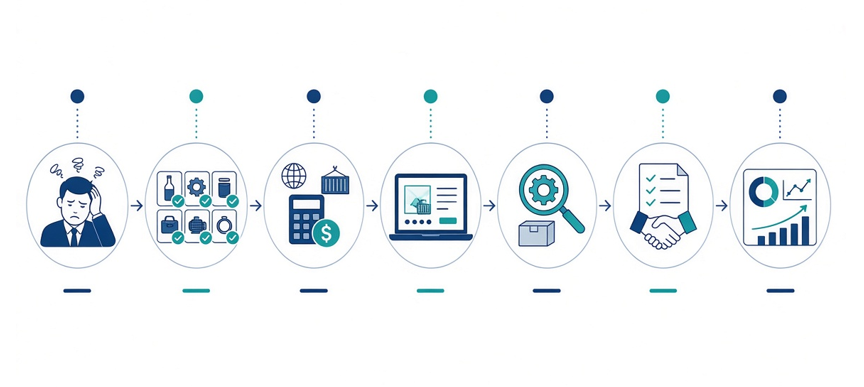
The USA B2B marketplaces landscape is no longer just a place to list products. For global sellers, it is now a procurement system that connects product discovery, supplier qualification, order execution, inventory decisions, payment, and delivery. If you sell to businesses in the United States—or source Chinese products to serve them—the right marketplace and fulfillment workflow can reduce working-capital pressure without compromising buyer experience.
From years of working with export-oriented sellers and procurement teams, one lesson is consistent: the lowest unit price is rarely the lowest total cost. A marketplace may help a buyer discover a supplier, but the real commercial outcome depends on sample validation, communication speed, packaging accuracy, stock visibility, and reliable cross-border fulfillment. This guide explains how to evaluate US B2B marketplace opportunities and build a practical China-sourcing and dropshipping model around them.
> Key takeaway: Use marketplaces to create demand and compare supply, but use a disciplined sourcing and fulfillment process to protect margin, delivery reliability, and customer trust.
Table of Contents
Why USA B2B Marketplaces Matter Now
B2B procurement has become distinctly more digital and more complex. Buyers do not follow one linear path from search to purchase. McKinsey reports that B2B buyers use an average of ten channels during the purchasing journey and expect consistent information as they move among digital self-service, remote interactions, and in-person contact. In practice, that means a buyer might find a product through a marketplace, request specifications by email, validate a supplier in a video call, and place a repeat order through an integrated purchasing workflow.
Online commerce in the United States continues to grow. According to the latest data released by the U.S. Census Bureau on August 18, 2026, U.S. e-commerce sales reached approximately $340.2 billion in the second quarter of 2026, accounting for 17.1% of total U.S. retail sales, representing a year-on-year increase of 12.2%.That is retail data rather than a direct measure of the B2B market, but it is an important signal: digital product research, ordering, tracking, and service have become normal commercial expectations.
For a seller or reseller, the implication is straightforward. Your product catalog must be understandable without a sales call, your pricing rules must be explainable, and your operations must support the promise made on the product page.
What B2B Buyers Expect
Modern business buyers usually evaluate more than a catalog and a quoted price. They want:
– Clear specifications, dimensions, materials, compatibility, certifications, and use cases.
– Reliable supplier evidence, such as factory information, sample history, response quality, and documented quality controls.
– Predictable landed cost, including product, packaging, freight, duties where applicable, payment fees, and returns exposure.
– Flexible order handling, from samples and small test runs to recurring bulk orders.
– Accurate fulfillment visibility, especially when products move from China to overseas customers.
– Fast issue resolution, because delayed answers can delay an entire buyer project.
Four Marketplace Models to Understand
Not every B2B marketplace solves the same problem. Choosing the wrong model can produce poor lead quality, weak margins, or a fulfillment process that does not scale.
| Marketplace model | Best fit | Typical strengths | Operational watch-outs |
| Broad B2B marketplace | General merchandise, sourcing, international trade | Large supplier or buyer reach; broad category coverage | Quality varies; verification and samples are essential |
| Industry-focused marketplace | Industrial parts, electronics, medical, specialty goods | Better category relevance; technical filters; more qualified demand | Smaller audience; technical content must be precise |
| Procurement marketplace | Companies buying repeatable business supplies | Approval workflows, business pricing, invoicing, repeat ordering | Product data, availability, and service levels matter greatly |
| Managed sourcing and fulfillment platform | Sellers who want China supply with less inventory exposure | Supplier coordination, inspection, consolidation, shipping support | Confirm service scope, accountability, and destination capabilities |
Well-known platforms illustrate these distinctions. Amazon Business serves organizations across many categories and says it supports more than eight million organizations globally; it also states that 97 of the Fortune 100 purchase Amazon Business products. Alibaba and Global Sources are widely used for international supplier discovery, while Thomasnet is strongly associated with North American industrial sourcing.
Marketplace Discovery Is Not Supplier Approval
This distinction is where many new sellers lose money. A marketplace profile is a starting point, not proof that a supplier can consistently meet your requirements.
Before a first commercial order, verify the following:
1. Business identity and manufacturing role. Determine whether the company is a factory, a trading company, or both. Ask which production steps it controls directly.
2. Product documentation. Request current specifications, test reports where relevant, packaging details, minimum order quantities, and production lead times.
3. Sample-to-bulk consistency. Approve a sample against a written checklist, then state which tolerances and materials must remain unchanged in bulk production.
4. Communication discipline. Assess whether the supplier answers technical questions clearly, flags risks early, and documents changes in writing.
5. Quality-control process. Confirm inspection points, defect handling, photo/video records, and how rework or replacement decisions are made.
6. Trade and logistics terms. Clarify Incoterms, who controls booking, insurance, export paperwork, customs responsibility, and final-mile delivery.
Expert view: A supplier that gives a slightly higher quote but provides consistent specifications, transparent lead times, and responsive problem-solving often generates a better margin than a cheaper supplier that creates returns, rework, or missed delivery dates.
How to Choose a B2B Marketplace for Your Business
The right decision begins with your business model—not with which marketplace has the most traffic. Use the following scorecard before opening an account, running ads, or uploading a large catalog.
| Evaluation area | Questions to ask | Evidence to request or measure |
| Buyer fit | Are the marketplace’s buyers in your target industry, region, and order-value range? | Category demand, buyer type, lead quality, repeat-order potential |
| Product fit | Can buyers understand and compare your products online? | Complete attributes, images, certifications, variant logic, samples |
| Margin fit | Can you earn after all costs, not only factory price? | Landed-cost model, marketplace fees, payment charges, returns allowance |
| Fulfillment fit | Can you meet the delivery promise for both trial and repeat orders? | Processing time, shipping options, tracking, destination restrictions |
| Trust fit | Can you demonstrate reliability to an unfamiliar buyer? | Supplier records, quality checks, policies, references, response time |
| Systems fit | Can the workflow connect to your store, OMS, ERP, or customer service process? | API, CSV, inventory sync, order-status updates, reporting |
A Simple 30-Day Launch Plan
For businesses testing USA B2B marketplace demand, a controlled launch is better than uploading thousands of unvalidated SKUs.
1. Choose one buyer problem. For example: small retailers need low-MOQ, private-label kitchen accessories without committing cash to a container order.
2. Build a test assortment. Start with 20–50 products that have clear specifications, stable supply, manageable variations, and reasonable shipping profiles.
3. Calculate landed cost per SKU. Include product cost, domestic China handling, inspection, packaging, international freight, marketplace fees, payment costs, and an allowance for defects or returns.
4. Create decision-ready product pages. Include real dimensions, material composition, carton information, lead-time range, MOQ, customization options, and clear photos.
5. Order and inspect samples. Use the same product, packaging, and branding configuration intended for live orders whenever possible.
6. Define service-level rules. Set response-time targets, order cut-off times, replacement rules, and escalation procedures before the first customer issue arrives.
7. Measure the full funnel weekly. Track inquiry-to-quote rate, quote-to-order rate, sample conversion, gross margin after fulfillment, on-time dispatch, defects, and repeat orders.
A Low-Inventory China Sourcing Model
A low-inventory model does not mean a no-risk model. It means moving risk from speculative stock ownership toward disciplined order orchestration. For many global B2B sellers, the goal is to avoid buying deep inventory before demand is proven while still delivering a professional customer experience.
A managed sourcing and dropshipping partner such as Looperbuy can support this workflow by coordinating Chinese product sourcing, supplier communication, purchasing, quality checks, consolidation, and shipment handling. The seller remains responsible for the customer offer, product positioning, pricing, and service promise; the operating partner helps turn approved demand into fulfilled orders.
Where the Model Creates Value
– Reduced inventory commitment: Test new categories without placing large speculative orders.
– Broader product access: Source from China’s supplier ecosystem without managing every supplier conversation independently.
– Consolidated operations: Combine suitable items or supplier orders to reduce fragmented handling.
– More focus on selling: Spend more time on catalog strategy, buyer relationships, and demand generation rather than repetitive procurement tasks.
– Scalable repeat ordering: Once a product and supplier are proven, use standardized specifications and workflows for faster replenishment.
Where You Still Need Control
Do not outsource judgment. Keep direct control of:
– Your approved product specifications and brand requirements.
– The final customer-facing delivery estimate.
– Your quality threshold and defect-resolution policy.
– Product compliance research for the target market.
– Customer communication when a shipment, replacement, or refund requires a decision.
This division of responsibility is critical. A sourcing partner can make execution easier, but a marketplace seller still owns the promise made to the buyer.
Build Trust Before You Scale
Marketplace growth becomes expensive when problems are discovered only after a buyer places a high-value order. Build a repeatable trust system first.
The Supplier Performance Dashboard
Review each strategic supplier monthly using a simple scorecard:
| Metric | Why it matters | Practical target |
| Quote response time | Protects sales momentum | Reply within one business day for routine requests |
| Sample approval rate | Shows alignment between listing and actual product | Track approvals and root causes of rejection |
| On-time production | Determines the credibility of your delivery promise | Measure against agreed production date |
| Inspection pass rate | Identifies quality drift before shipping | Track defects by type and supplier |
| Order accuracy | Prevents wrong variants, labels, and quantities | Compare packing list, purchase order, and inspection record |
| Issue resolution time | Limits buyer dissatisfaction | Record time from report to agreed solution |
Amazon Business’s supplier-consolidation guidance makes a related point: supplier decisions should consider quality, pricing consistency, delivery reliability, certifications, and capacity to support future demand, then be monitored through performance data.
Example: Testing a Private-Label Office Supply
Imagine a US online seller wants to add a private-label desk organizer for small offices. Rather than ordering 3,000 units immediately, the seller can launch with a small approved assortment and a validated supplier.
The process could look like this:
– Define exact material, dimensions, color tolerance, logo position, inner packaging, and carton limits.
– Request samples from two or three qualified suppliers.
– Use a photo-based inspection checklist to compare samples objectively.
– Model landed cost at 50, 200, and 1,000 units to see when the economics improve.
– Open the offer with a transparent lead-time range rather than an unrealistic delivery promise.
– Monitor cancellations, defects, and reorder behavior for the first 30–60 days.
If the product earns repeat demand and meets quality expectations, the seller can negotiate improved pricing, pre-position carefully chosen stock, or introduce complementary products. If it fails, the financial exposure stays limited.
Common Mistakes That Reduce Marketplace Profit
The following errors appear repeatedly in cross-border B2B operations:
– Selling on factory price alone. A quote without freight, handling, fees, and returns allowance is not a margin calculation.
– Using generic product descriptions. Business buyers need specifications and compatibility details, not only marketing adjectives.
– Treating supplier verification as a one-time task. Performance can change with capacity, materials, staff, or seasonality.
– Promising delivery before validating the route. Delivery estimates should reflect product readiness, inspection, consolidation, line-haul, customs, and final-mile handoff.
– Adding too many SKUs too early. A smaller, well-documented catalog is easier to sell and fulfill than a vast catalog with unstable availability.
– Ignoring post-order service. The buyer remembers how you handle an exception more than how attractive the listing looked.
Final Recommendation for Global B2B Sellers
USA B2B marketplaces offer access, but sustainable growth comes from operating discipline. Select channels based on buyer fit, validate suppliers beyond their storefronts, calculate landed cost before quoting, and make fulfillment visibility part of the product experience.
For sellers who want to source Chinese goods without tying up capital in large inventory positions, Looperbuy can help coordinate sourcing and dropshipping workflows—from finding suitable products and communicating with suppliers to quality checks, consolidation, and shipping support. Start with a focused product test, document every requirement, and scale only after your quality, margin, and delivery data prove the model.
Ready to test a China-sourcing workflow for your B2B catalog? Contact Looperbuy to discuss your target products, expected order volume, destination markets, and fulfillment requirements.
Frequently Asked Questions
1. What is a B2B marketplace?
A B2B marketplace is a digital platform where businesses discover, compare, buy, or sell products and services to other businesses. Depending on the platform, it may support supplier discovery, RFQs, catalog ordering, business pricing, payments, order tracking, and procurement approvals.
2. Which USA B2B marketplace is best for a new seller?
There is no universal best option. Choose based on your category, target buyer, order size, geographic reach, product-data requirements, fees, and fulfillment capability. Broad platforms may offer reach, while vertical marketplaces may provide more relevant and technically informed buyers.
3. How can I source from China without holding large amounts of inventory?
Begin with a small validated assortment, use samples and written specifications, calculate landed cost, and fulfill approved orders through a coordinated sourcing and shipping workflow. This reduces speculative inventory exposure, but you must still manage lead-time promises, quality standards, and customer service.
4. What should I check before choosing a Chinese supplier?
Verify the supplier’s business role, product documentation, sample consistency, quality-control process, communication reliability, production capacity, packaging capability, and trade terms. Treat the first orders as measured tests rather than automatic proof of long-term reliability.
5. How do I calculate landed cost for B2B products?
Add the factory product cost, packaging, China-side handling, inspections, freight, insurance where used, customs duties and taxes where applicable, marketplace fees, payment fees, and an allowance for defects, returns, or reshipments. Divide by the number of sellable units—not simply the number shipped.
6. Is dropshipping suitable for B2B orders?
It can be suitable for small test orders, long-tail catalogs, and businesses that need to preserve cash flow. It is less suitable when buyers demand immediate delivery, highly customized packaging, or large recurring volumes that justify local stock. The best approach often combines dropshipping for testing with selective inventory for proven fast-moving items.
7. What metrics should I track after launching on a B2B marketplace?
Track inquiry-to-quote conversion, quote-to-order conversion, gross margin after fulfillment, sample approval rate, on-time dispatch, delivery performance, defect rate, refund or replacement rate, response time, and repeat-order rate. These metrics reveal whether apparent sales growth is actually profitable and sustainable.
References
1. Virto Commerce. “The Ultimate Guide to Thriving in the US B2B Marketplaces in 2024.” Platform landscape, marketplace examples, selection criteria, and earlier market context. [Read the article].
2. McKinsey & Company. “The surprising economics of B2B growth: The new survival threshold and what it takes to thrive.” Buyer channel behavior and omnichannel expectations. [Read the report].
3. U.S. Census Bureau. “Estimated Quarterly U.S. Retail Sales: Total and E-commerce.” Q4 2025 U.S. e-commerce sales and share of retail sales. [View the data].
4. Amazon Business. “Celebrating 10 years.” Organizational reach and procurement adoption. [Read the article].
5. Amazon Seller. “How to find B2B products to sell on Amazon.” Amazon Business customer and Fortune 100 participation statements. [Read the article].
6. Amazon Business. “Supplier consolidation guide for better control and savings.” Supplier evaluation and ongoing performance-management guidance. [Read the guide].